
What is Flexographic Printing?
Flexographic printing (or “flexo”) is a high‑speed, relief‑printing process that uses flexible photopolymer or rubber plates to transfer ink onto a wide range of substrates – from films, papers, and foils to corrugated board. It is one of the most popular printing methods for packaging, labels, and industrial materials.
1. Process overview & equipment selection. 2. 2‑color to 8‑color CI and stack presses.
3. Factory‑direct inquiries · Quote‑based pricing.
Key Points
| Question | Answer |
|---|---|
| What is flexographic printing? | A relief printing process that uses flexible plates and anilox rollers to transfer fast‑drying inks onto virtually any substrate, including film, paper, foil, and corrugated board. |
| How does flexo printing work? | Ink is metered by an anilox roller and doctor blade, transferred to the raised image areas of a flexible plate, then pressed onto the moving substrate by an impression cylinder. |
| Flexo vs gravure? | Flexo uses flexible plates and low‑viscosity inks; gravure uses engraved metal cylinders. Flexo offers faster setup and lower plate cost, ideal for short‑to‑medium runs, while gravure suits very long runs with consistent quality. |
| What products are printed with flexo? | Flexible packaging films, shrink sleeves, labels, folding cartons, corrugated boxes, paper bags, medical packaging, and more. |
| Who builds flexo presses? | Factory manufacturers such as ZHUXIN Machinery supply CI and stack flexo presses for export markets. |
| How do you buy / price one? | Flexo presses are quote‑based capital equipment. Share print width, colors, substrate, speed, and drying requirements to receive a factory quotation — no public list prices. |
How does flexographic printing work?
The core is “metered ink transfer from a flexible plate onto the substrate”: a ceramic or chrome anilox roller carries a precise film of ink, which is then wiped by a doctor blade. The flexible plate, mounted on a plate cylinder, picks up ink only on its raised image areas and transfers it to the substrate as it passes between the plate cylinder and the impression cylinder.
Each color station operates independently, and between stations the printed web passes through dryers (hot‑air, IR, or UV) to set the ink before the next color is applied. In a central impression (CI) press, all printing units are arranged around a single large impression cylinder, ensuring perfect registration. In a stack press, the units are stacked vertically, which is common for paper and board.
Flexo printing is known for its versatility, high speed (up to 300+ m/min), and ability to print on both porous and non‑porous substrates using water‑based, solvent‑based, or UV‑curable inks.
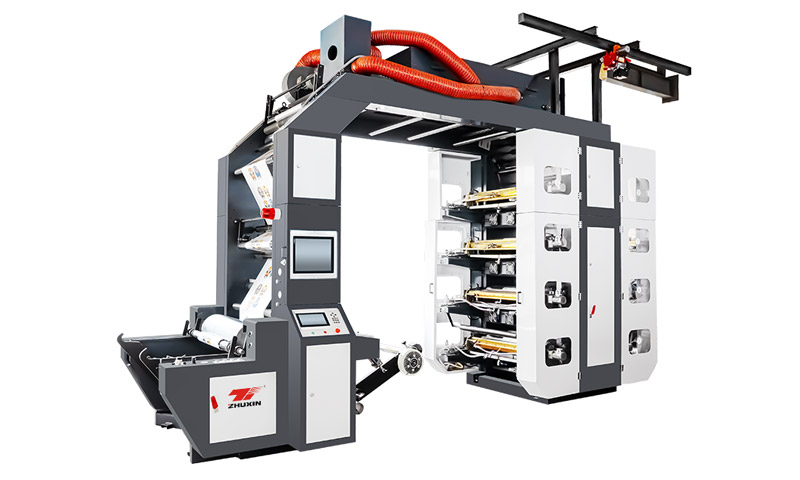
Flexo Printing Process Steps
A typical flexo press line follows the sequence: unwind → print stations (each with anilox, plate cylinder, impression) → inter‑station drying → final rewind, with register control throughout.

Unwind & tension control
The substrate roll is mounted on an unwind stand with automatic tension control to ensure a steady feed into the first print unit.
Anilox inking
The ceramic or chrome anilox roller picks up ink from the chambered doctor blade and transfers a consistent film thickness to the plate.
Plate & impression
The flexible plate (photopolymer or rubber) carries the image. The impression cylinder presses the substrate against the plate to transfer the inked pattern.
Inter‑station drying
Hot‑air, IR, or UV dryers between color stations cure the ink before the next color is applied, preventing smearing and enabling high speeds.
Register control
Automatic register systems track color‑to‑color alignment using optical sensors and adjust plate cylinder positions in real time for precise registration.
Rewind
Finished printed rolls are wound with tension and edge‑guide control, ready for slitting, lamination, or bag conversion.
Flexo Printing Process Flow
The material path can be summarised as: substrate roll → unwind → each color station (inking → printing → drying) → rewind.

Unwind & tension
Anilox inking
Plate printing
Drying
Register control
Final drying
Rewind
Slitting (optional)
Note: The above is a logical flow. Actual press configurations (CI, stack, inline) differ in layout and drying lengths.
Flexo vs Gravure: What's the difference?
Both are used for high‑volume printing, but they differ in plate/cylinder technology, ink viscosity, setup time, and cost structure.
Plate/cylinder
Flexo uses flexible photopolymer or rubber plates (relief); gravure uses engraved metal cylinders (intaglio).
Ink transfer
Flexo: anilox roller meters ink; gravure: ink is picked up directly from the engraved cells.
Setup time & cost
Flexo plates are cheaper and faster to produce, making it economical for short‑to‑medium runs; gravure cylinders are expensive and slow to engrave, favouring very long runs.
Print quality
Gravure traditionally offers higher consistency and finer detail, but modern flexo with HD plates and sleeve technology has closed the gap significantly.
Substrate versatility
Flexo can print on almost any substrate (film, paper, board, foil) with appropriate inks; gravure is more common on film and paper.
Ink and drying
Flexo uses low‑viscosity inks (water, solvent, UV) that dry quickly; gravure uses solvent‑based inks that require longer drying tunnels.
Typical Products & Applications
Flexo printing serves a vast array of markets – from food packaging and labels to industrial and medical applications.
Packaging & Labels
- ● Flexible packaging films (snacks, frozen food, etc.)
- ● Shrink sleeves and stretch labels
- ● Self‑adhesive labels and release liners
- ● Folding cartons and paperboard boxes
Industrial & Specialty
- ● Corrugated board (direct or pre‑print)
- ● Paper bags and sacks
- ● Medical packaging, sterile pouches, blister foils
- ● Decorative and wallcovering materials
How to Choose a Flexo Printing Machine
Match color count, print width, substrate, speed, drying method, and automation level to your production needs — then confirm with the manufacturer.
Print colors
2‑color for simple line work; 4‑color for CMYK process; 6‑ or 8‑color when spot colors, white, or varnish are required.
Substrate type
Film (PE, PP, PET, BOPP) needs CI presses with good tension control; paper and board can run on stack presses.
Print width & repeat
Size the max print width and repeat length to your product range – common widths from 600 mm to 2000 mm.
Speed
Target m/min against shift output; CI presses typically run 200–300 m/min, stack presses 150–200 m/min for board.
Drying system
Hot‑air is standard for solvent‑ and water‑based inks; UV drying is required for UV inks and some film applications.
Controls & automation
Automatic register control, PLC touch‑screen, viscosity control, and web guiding protect quality and reduce waste.
Supplier fit
Factory‑direct builders who machine critical parts in‑house and publish QC, OEM, R&D, and service commitments reduce integration risk.
Pricing information: The price of flexo presses varies widely depending on colors, width, automation, drying type, and brand of components. ZHUXIN Machinery operates on a quotation‑based model and does not publish list prices. ZHUXIN Machinery is a factory‑direct B2B manufacturer based in Wenzhou, China, with extensive experience in printing machinery and export track record to global markets.
How does ZHUXIN Machinery support flexo printing lines?
ZHUXIN Machinery is a factory‑direct manufacturer of CI and stack flexo presses, from 2‑color to 8‑color configurations, with a focus on packaging and label printers.
Positioning: Industrial printing equipment – flexo presses; B2B export, configured upon inquiry.
Capability range: 2, 4, 6, and 8‑color CI presses, as well as stack‑type presses for paper and board.
Structural features: Automatic register control, chambered doctor blades, hot‑air/UV drying, PLC and Siemens drives, turret rewind.
Factory strength: Factory area ~6500 m², 120+ employees, 30+ Countries & regions; established in 1989.
Factory area
Years
Countries & regions
Founded in
Select by Color Count for Flexo Presses
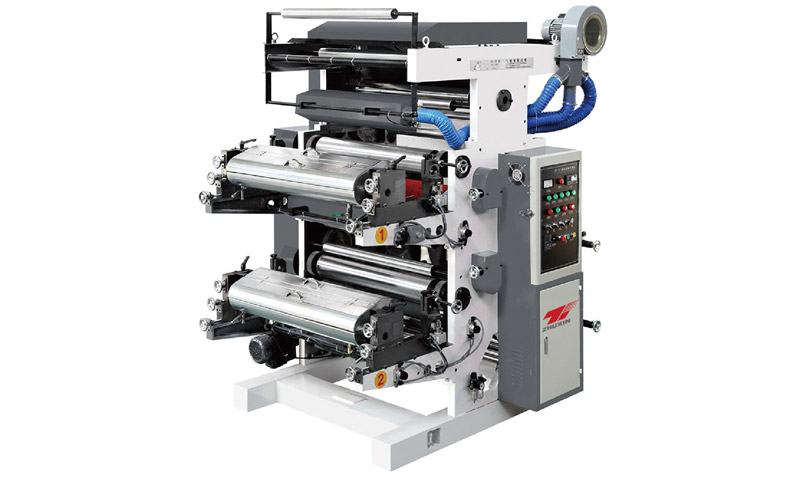 2‑Color Flexo Printing Machine
Highlights: Basic CI or stack press for one‑ or two‑color line printing.
Substrates: Film, paper, bags.
Applications: Simple packaging, industrial sacks.
VIDEO →VIEW →
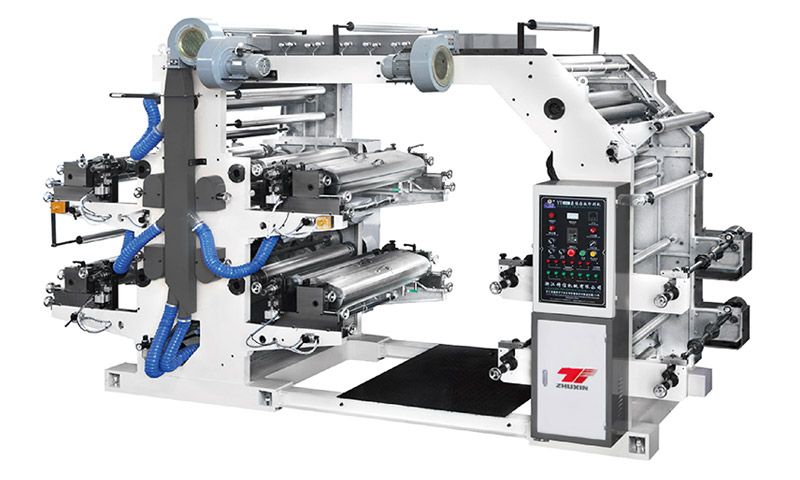 4‑Color Flexo Printing Machine
Highlights: CI press for CMYK process printing.
Substrates: Film, shrink sleeves, labels.
Applications: Flexible packaging, medium‑complexity labels.
VIDEO →VIEW →
Highlights: CI press with extended gamut (CMYK + 2 spot/PMS).
Substrates: Film, labels, cartons.
Applications: Premium food packaging, cosmetic labels.
VIEW →
Highlights: High‑end press with automatic register, drying tunnels, PLC.
Substrates: Film, foil, board.
Applications: Process + spot + white + varnish.
VIDEO →VIEW →
Highlights: Vertical colour decks, easy plate change.
Substrates: Paper, board, corrugated.
Applications: Cartons, boxes, paper bags.
VIEW →
Frequently Asked Questions
Ready to specify your flexo printing line?
ZHUXIN Machinery factory team in Wenzhou China – inquiry‑first export OEM for packaging and label producers worldwide.