
 HOT LINE: +86-13968935808
We offer flexo printing machines and complete packaging solutions, certified by CE and ISO9001.

STACK FLEXO PRINTING MACHINE
STACK FLEXO PRINTING MACHINE


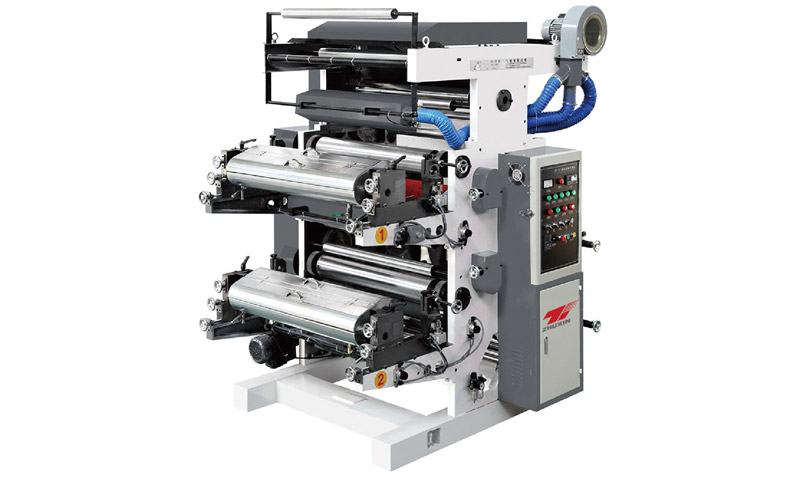
1. Printing Speed: The printing speed of the two-color flexographic printing machine can reach 0–50 meters per minute, with a mechanical speed of 160 meters per minute.
2. Automation Level: The equipment features a high degree of automation, enabling one-pass completion of printing, laminating, and die-cutting processes, thereby improving production efficiency.
3. Applicable Materials: Suitable for continuous multi-color printing on various roll-type materials, including BOPP, PET, PE, PVC, CPP, glassine paper, paper, and aluminum foil.
4. Printing Effect: Delivers bright colors, high printing accuracy, and excellent color saturation, meeting diverse personalized printing requirements.
5. Ink Characteristics: The inks used are temperature-resistant, light-resistant, and abrasion-resistant, resulting in printed products with strong durability and consistent quality.
| Model | YT-2600 | YT-2800 | YT-21000 |
| Maximum Material Width | 600mm | 800mm | 1000mm |
| Maximum Printing Width | 560mm | 760mm | 960mm |
| Range of printing length | 200-1100mm | 180-1000mm | 200-1100mm |
| Max diameter of web | ф450mm | ||
| Maximum Printing Speed | 5-50m/min | ||
| Dimensions | 1900x1800x2300mm | 1900x2000x2300mm | 1900x2200x2400mm |
| Plate thickness | 2.38mm | ||
Q: Why does my 2 Colors Flexo Printing Machine produce dot gain that ruins fine text and halftones?
Dot gain on a 2 Colors Flexo Printing Machine is often caused by excessive impression pressure, too soft plate durometer (below 60 Shore A), or anilox volume that is too high for the line screen. To fix, first reduce impression pressure until you see a slight kiss impression. Switch to a harder plate (70–75 Shore A) for fine details. Use an anilox roller with lower volume (e.g., 2.5–3.0 BCM for 150 lpi halftones). Also check that the plate is properly backed with a 1.14 mm compressible tape. After adjustments, dot gain can drop from 25% to under 12%, restoring sharp text and smooth gradients.
Q: How often should I replace the impression cylinder bearings on a 2 Colors Flexo Printing Machine?
On a 2 Colors Flexo Printing Machine, impression cylinder bearings typically last 8,000–10,000 running hours under normal loads. However, if you frequently print heavy solids or run at maximum width, check bearings every 6 months for play or noise. Symptoms of worn bearings: vertical bar marks on prints, uneven pressure across web, and low‑frequency rumble. Replace both sides at the same time with sealed, high‑precision bearings (P6 class). A bearing failure can damage the cylinder surface costing >$2,000, so preventive replacement every 12–18 months is cheaper than downtime.
Q: Can I run water‑based inks and UV inks on the same 2 Colors Flexo Printing Machine without cross‑contamination?
Yes, but a 2 Colors Flexo Printing Machine requires thorough cleaning when switching between water‑based and UV inks. UV inks cure instantly and are incompatible with water‑based systems. To avoid contamination, dedicate separate anilox rollers, doctor blades, and chamber seals for each ink type – label them clearly. After running water‑based ink, wash the entire ink circuit with water and mild detergent, then dry completely before adding UV ink. UV ink residue mixed with water‑based ink will coagulate and clog anilox cells. Many printers buy a second set of ink pans and pumps to make the switch in under 30 minutes.
Q: My 2 Colors Flexo Printing Machine creates static shocks when printing thin films. How do I stop it?
Static buildup on a 2 Colors Flexo Printing Machine running thin PET or OPP films (below 50 microns) can cause shocks, dust attraction, and even web breaks. Install passive or active static eliminator bars (e.g., with ±5kV ionization) before the unwind, after each print station, and at the rewind. Also increase ambient humidity to 50–60% using a humidifier. Connect all rollers and press frame to ground with copper straps. For severe cases, add a conductive rubber idler roller that bleeds static continuously. Eliminating static also improves print quality by preventing "snowflakes" from dust.
Q: What is the smallest font size I can reliably print on a 2 Colors Flexo Printing Machine?
On a standard 2 Colors Flexo Printing Machine, the smallest readable font size is 4 pt (1.4 mm x‑height) for positive text, and 5 pt for reverse (knockout) text, assuming a high‑quality plate (0.95 mm thickness, 65–70 Shore A) and a 400 lpi anilox roller with 1.5 BCM volume. To go smaller (3 pt), you need a dedicated sleeves system, zero‑deflection cylinders, and very tight registration. At high speed (150 m/min), dot gain will round off fine serifs. Always run a test ramp before production. For most packaging applications, 5 pt is the safe minimum on a two‑color flexo press.
05/15
2026
Reducing Set-up Waste on a 2 Colors Flexo Printing Machine: Lean Techniques
Job changeover waste—scrap material generated while bringing the press into register and color specification—can be a huge cost for flexo printers. Typical waste per changeover ranges from 200 to 1000 linear meters. Lean techniques can slash this waste dramatically. The first ste...
04/29
2026
Energy Efficiency Upgrades for Existing 2 Colors Flexo Printing Machines
Not every shop can buy a brand-new 2 Colors Flexo Printing Machine, but significant energy savings can be achieved through upgrades. The largest energy consumers on a typical flexo press are the dryers (hot air or IR), followed by main drive motors, and then auxiliary equipment l...
04/29
2026
Selecting Inks and Coatings for Your 2 Colors Flexo Printing Machine: A Practical Guide
The choice of ink directly affects the performance and output of any 2 Colors Flexo Printing Machine. Flexo inks are broadly classified as water-based, solvent-based, and energy-curable (UV/EB). Water-based inks are the most common for paper, paperboard, and corrugated. They are ...
04/29
2026
The Future of 2 Colors Flexo Printing Machine: Industry 4.0 and Predictive Analytics
The fourth industrial revolution is transforming manufacturing, and the 2 Colors Flexo Printing Machine is at the forefront of this change. Industry 4.0 concepts—interconnectivity, data analytics, cyber-physical systems—are being integrated into flexographic presses. A future-rea...