
 HOT LINE: +86-13968935808
We offer flexo printing machines and complete packaging solutions, certified by CE and ISO9001.

HIGH SPEED FLEXO PRINTING MACHINE
HIGH SPEED FLEXO PRINTING MACHINE
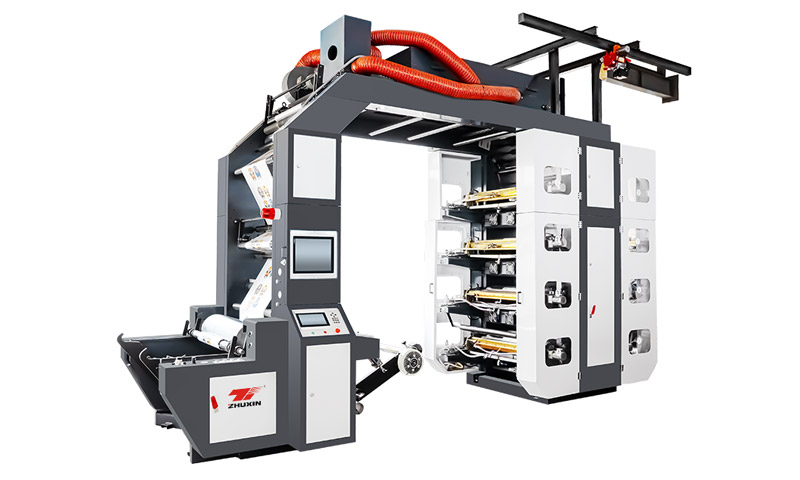
1. We utilize a high-precision synchronous belt drive system, which operates more quietly and smoothly than chain-driven alternatives. Unlike budget multi-color printers, it maintains precise color alignment even during rapid starts, stops, or speed changes—a feature we've rigorously tested and proven superior for detailed prints.
2. Material feeding and winding are managed by dual hydraulic-pneumatic systems combined with a friction winder, directly addressing customer complaints about loose rolls after multi-color printing. This setup ensures finished rolls are tightly wound and uniformly shaped, simplifying downstream processing.
3. The unwinding section features automatic EPC (edge position control) correction and hydraulic operation, eliminating manual lifting and constant adjustments. Customers report this saves at least one labor hour per shift.
4. The main unit incorporates a frequency converter for stepless speed regulation, offering energy-efficient operation with stable performance. Speed can be adjusted between 8-100m/min, accommodating both small-batch runs and full-scale production.
5. The printing plate lifts hydraulically for effortless changeovers, while helical gears in the plate roller reduce wear and extend machine lifespan—a critical consideration given the high cost of production downtime.
6. A pre-start alarm system alerts operators to potential issues before machine activation, helping prevent costly damage or accidents. This safety enhancement was added in response to customer demand for more robust protection features.
7. Dual blowing and heating systems come standard with precise temperature control, allowing adjustments based on ink type and material thickness (e.g., less heat for thin films, more for thick paper). This ensures rapid, uniform ink drying without smudging.
8. The bottom roller is crafted from special steel, processed with our proprietary treatment, and electroplated with a 10-wire-thick hard chrome layer for exceptional wear resistance and pressure tolerance—maintaining flatness even after years of heavy use.
9. Aluminum alloy guide wheels undergo hard oxidation and balance treatments, reducing material friction to prevent shifting that could damage rolls while extending component lifespan.
10. We've integrated a cold air bellows system to rapidly cool prints after drying, preventing ink adhesion or fading and improving the overall qualified rate. Testing shows this reduces waste by approximately 5%.
11. The user-friendly operation interface enables quick training for new operators, while the machine's modular design simplifies maintenance—built specifically for the demanding, continuous operation required by most packaging factories.
12. Prints emerge with exceptional sharpness, vibrant colors, and clear layering. The machine handles common materials including PE/PP film, paper, woven bags, and non-wovens. Compared to our 6-color model, it delivers deeper color saturation without compromising speed.
Model | YT-600S | YT-800S | YT-1000S | YT-1200S |
Max.width of substrate | 600mm | 800mm | 1000mm | 1200mm |
Max.printing width | 560mm | 760mm | 960mm | 1160mm |
Printing materials | PE PP Film / Paper / Woven bag / Non-woven | |||
Printing speed | 120m/min | 120m/min | 120m/min | 120m/min |
Plate thickness | 1.14-3.94 | 1.14-3.94 | 1.14-3.94 | 1.14-3.94 |
Weight of machine | 5000 | 5500 | 6000 | 6500 |
Machine size (L×W×H) | 6.8×1.8×2.9m | 6.8×2×2.9m | 6.8×2×2.9m | 6.8×2.5×2.9m |
Q: How to purchase products from your company?
You can purchase our products through our company's official website or search for our authorized agents in the market. If you encounter any problems during the purchasing process, our team will be available to provide assistance and support at any time.
Q: Why does my 8 Colors High Speed Flexo Printing Machine cause excessive noise at the gear train?
Excessive gear noise on a 8 Colors High Speed Flexo Printing Machine usually means worn helical gears or insufficient lubrication. At high speed (200+ m/min), worn gears produce a rhythmic clattering. Immediately stop the press and check the gear oil level – contaminated oil with metal particles indicates internal wear. Replace the gear set if backlash exceeds 0.2 mm. Also ensure the gears are properly aligned; misalignment due to loose mounting bolts amplifies noise. Running with noisy gears leads to ghosting and eventual print cylinder damage. Schedule a weekly oil change and vibration check.
Q: How do I choose the right anilox roller line count for my 8 Colors High Speed Flexo Printing Machine?
Choosing anilox for a 8 Colors High Speed Flexo Printing Machine depends on the job: for solid blocks and large text, use 200–300 lpi with 4–6 BCM volume. For fine text (4 pt) and halftones (up to 120 lpi screen), use 400–500 lpi with 1.8–2.5 BCM. A common mistake is using the same anilox for both colors – instead, put the finer anilox on the color that needs detail, and the coarser one on the solid background. Running a 400 lpi anilox on both decks is safe for general work. Always buy anilox rollers with a ceramic coating and at least 30% cell volume reserve. Test combinations with a step wedge before production.
Q: How long can your machine work continuously?
Our machines can work 24 hours a day without interruption, which not only increases production but also saves energy.
Q: Can a 8 Colors High Speed Flexo Printing Machine print on both paper and PE film without changing major parts?
Yes, a versatile 8 Colors High Speed Flexo Printing Machine can switch between paper (40–120 gsm) and PE film (25–80 microns) using the same print cylinders but different anilox rollers and ink types. For paper, use 250–300 lpi anilox with water-based inks; for PE film, go to 350–400 lpi anilox with solvent or UV inks. You‘ll also need to adjust nip pressure and dryer temperature. Many modern 2‑color high‑speed presses come with quick‑change anilox sleeves and digital pressure settings, allowing changeover in under 15 minutes without tools.
04/29
2026
Selecting Inks and Coatings for Your 2 Colors Flexo Printing Machine: A Practical Guide
The choice of ink directly affects the performance and output of any 2 Colors Flexo Printing Machine. Flexo inks are broadly classified as water-based, solvent-based, and energy-curable (UV/EB). Water-based inks are the most common for paper, paperboard, and corrugated. They are ...
04/28
2026
Training Operators for the Modern 6 Colors High Speed Flexo Printing Machine: Best Practices
A high-tech 6 Colors High Speed Flexo Printing Machine is only as good as the person operating it. Comprehensive training is essential to unlock the machine's full potential. Best practices begin with pre-training: operators should understand basic flexography principles—ink ...
04/27
2026
Maintaining Register Accuracy on a 4 Colors High Speed Flexo Printing Machine: Tips and Techniques
Register accuracy—the precise alignment of multiple colors—is crucial for high-quality flexo printing. A 4 Colors High Speed Flexo Printing Machine that cannot hold register will produce blurry, unacceptable output. Several factors affect register. First is web tension. Fluctuati...
04/26
2026
Improving Efficiency with a Servo-Driven 2 Colors High Speed Flexo Printing Machine: Case Study
A mid-sized converter specializing in flexible packaging replaced an aging gear-driven 2 Colors High Speed Flexo Printing Machine with a new servo-driven model. The results were dramatic. The older press required manual adjustments for registration, often taking forty-five minute...