
 HOT LINE: +86-13968935808
We offer flexo printing machines and complete packaging solutions, certified by CE and ISO9001.

HIGH SPEED FLEXO PRINTING MACHINE
HIGH SPEED FLEXO PRINTING MACHINE


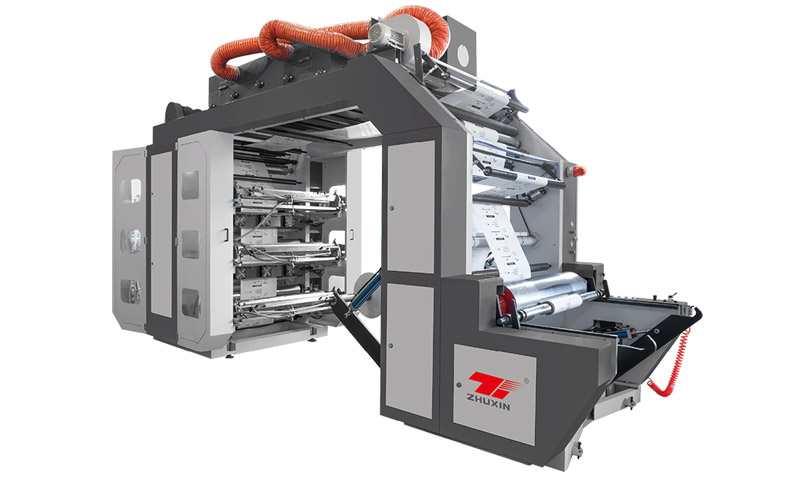
1. Easy to operate and convenient, with accurate color matching and long service life.
2. Equipped with a motor and variable frequency speed regulation, offering energy savings and minimal operational fluctuations.
3. The ink motor stops automatically when the plate is lowered, and the ink device starts automatically when the plate is started.
4. Adopts synchronous belt transmission for accurate printing dimensions.
5. Equipped with two sets of blowing and heating devices, with heating controlled by a central constant temperature control system and grouped operation.
6. The lower roller is made of special steel and treated with a special process, electroplated with a 10-wire-thick hard chromium protective layer.
7. Aluminum alloy guide wheels undergo hard oxidation as well as dynamic and static balancing treatment.
8. Equipped with a cold air shaping air duct (or bellows), which effectively prevents defects such as ink adhesion after printing.
9. Produces clear printed images with a strong sense of layering.
Model | YT-600 | YT-800 | YT-1000 |
Maximum Material Width | 600mm | 800mm | 1000mm |
Maximum Printing Width | 560mm | 760mm | 960mm |
Suitable Printing Materials | Paper and film between 20-350 grams | ||
Maximum Printing Speed | 120m/min | ||
Plate thickness | 1.7-3.4 | ||
Overall Machine Weight | 2000kg | 2200kg | 2500kg |
Dimensions | 6.8×1.8×2.9m | 6.8×2×2.9m | 6.8×2×2.9m |
Q: Which substrates are NOT suitable for a 6 Colors High Speed Flexo Printing Machine?
A standard 6 Colors High Speed Flexo Printing Machine struggles with highly stretchable films like cast polypropylene (CPP) under 20 microns, non‑woven fabrics with loose fibers, and corrugated board (due to thickness >4 mm). Extremely porous papers (newsprint) may cause ink strike‑through. Also, metalized films with poor surface treatment (<38 dynes/cm) won‘t hold ink at high speed. For such substrates, you would need a press with special tension control, corona treater, or a thicker‑board conversion kit. Always test your material at the supplier‘s demo center before committing to a six‑color high‑speed press.
Q: Why does my 6 Colors High Speed Flexo Printing Machine cause excessive noise at the gear train?
Excessive gear noise on a 6 Colors High Speed Flexo Printing Machine usually means worn helical gears or insufficient lubrication. At high speed (200+ m/min), worn gears produce a rhythmic clattering. Immediately stop the press and check the gear oil level – contaminated oil with metal particles indicates internal wear. Replace the gear set if backlash exceeds 0.2 mm. Also ensure the gears are properly aligned; misalignment due to loose mounting bolts amplifies noise. Running with noisy gears leads to ghosting and eventual print cylinder damage. Schedule a weekly oil change and vibration check.
Q: How do I prevent ink foaming in the chamber of my 6 Colors High Speed Flexo Printing Machine?
Ink foaming on a 6 Colors High Speed Flexo Printing Machine happens when the ink return line drops from height, or when pump speed is too high, or with low‑quality water‑based inks. Install a foambreaker insert inside the ink tank and use a slow‑pitch return tube that enters below the liquid surface. Reduce pump circulation speed by 20–30%. Add 0.1–0.3% non‑silicone defoamer approved for flexo inks. Also check that the ink temperature is not above 35°C (heat accelerates foaming). Keeping foam under control ensures consistent ink transfer and prevents starved anilox cells.
Q: What is the typical energy consumption of a 6 Colors High Speed Flexo Printing Machine running at full speed?
A modern 6 Colors High Speed Flexo Printing Machine with servo drives and efficient dryers consumes about 15–22 kW at 250 m/min, including heaters, blowers, and motors. Older AC motor machines may use 35–45 kW. You can reduce consumption by 25% by adding automatic idle-stop (motors sleep after 3 minutes of inactivity) and using infrared + hot air hybrid dryers. At $0.12/kWh, running 8 hours/day costs roughly $14–$21 per day for the new machine – significantly less than older models. Energy efficiency is a key selling point for high‑speed six‑color presses.
Q: My 6 Colors High Speed Flexo Printing Machine leaves streaks in the solid print area. How to fix?
Streaks on a 6 Colors High Speed Flexo Printing Machine are usually caused by a damaged doctor blade (nicks or wear), contaminated anilox roller (dried ink in cells), or a scratch on the impression cylinder. First, replace the doctor blade and clean the chamber. If streaks persist, remove the anilox roller and clean it with a specialized anilox cleaner and brass brush – do not use steel. For ceramic rollers, ultrasonic cleaning works best. Check the impression cylinder for embedded debris; polish with fine emery cloth. Finally, ensure the plate has no high spots. Fixing streaks recovers print quality without slowing down.
04/28
2026
Innovations in 6 Colors High Speed Flexo Printing Machine Plate Technology: From Solvent to Water-Washable
Printing plates are the image carriers in flexography, and plate technology has advanced significantly, directly impacting the quality and environmental footprint of a 6 Colors High Speed Flexo Printing Machine. Traditional solvent-wash plates require hours of processing using ha...
04/28
2026
Training Operators for the Modern 6 Colors High Speed Flexo Printing Machine: Best Practices
A high-tech 6 Colors High Speed Flexo Printing Machine is only as good as the person operating it. Comprehensive training is essential to unlock the machine's full potential. Best practices begin with pre-training: operators should understand basic flexography principles—ink ...
04/28
2026
Automation in 6 Colors High Speed Flexo Printing Machine: Reducing Operator Dependency and Human Error
The printing industry faces a skilled labor shortage, making automation a top priority for 6 Colors High Speed Flexo Printing Machine users. Automation can take many forms, from basic motorized adjustments to fully robotic plate and sleeve changing. At the entry level, an automat...
04/28
2026
UV LED vs. Conventional Drying on 6 Colors High Speed Flexo Printing Machine: A Technical Comparison
Drying technology is a critical component of any 6 Colors High Speed Flexo Printing Machine, affecting speed, energy use, and substrate options. Two dominant methods are conventional hot air (plus IR) and UV LED curing. Hot air dryers evaporate solvents or water from inks, leavin...