water-based flexo ink
Water-based flexo ink is a printing ink that uses water as the primary solvent, with pigments, resins, and additives dispersed in an aqueous medium. It is the most environmentally friendly flexo ink option, emitting negligible volatile organic compounds (VOCs) and posing lower fire and health risks compared to solvent-based systems. This makes it the preferred choice for food packaging, corrugated printing, and paper products where regulatory compliance and sustainability are critical.
The composition typically includes acrylic or styrene-acrylic resins as binders, organic or inorganic pigments, water as the carrier, and additives such as surfactants, defoamers, and waxes for slip and rub resistance. The pH level (usually 8.0-9.5) and viscosity are carefully controlled to ensure stable print performance. Water-based inks dry primarily by evaporation of water and absorption into porous substrates, which is slower than solvent or UV inks, requiring adequate drying systems.
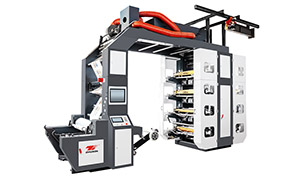
High Speed Flexo Printing Machine - Stack Flexo Flexo Printing Machine
Key advantages: low odor, non-flammable, easy cleanup with water, and excellent adhesion to paper and board. They also offer good color strength and can be formulated for high gloss or matte finishes. However, they are less suitable for non-porous films like polyethylene unless specially formulated with co-solvents or hybrid binders, as water does not wet plastic surfaces well.
Drying is the biggest challenge with water-based flexo inks. High hot air impingement dryers, often with temperatures between 60-120°C, are required to evaporate water rapidly. Infrared dryers can also be used for additional energy input. The drying efficiency directly affects press speed, as insufficient drying leads to smearing and set-off in rewound rolls. For thick layers or heavy coverage, slower speeds or extended dryer tunnels may be necessary.
Substrate compatibility: Water-based inks excel on kraft paper, corrugated board, paperboard, and uncoated papers. They are also used on coated papers with proper primer. For film printing, special water-based inks with co-solvents (e.g., glycols) or hybrid formulations are available, but they may require corona treatment and specific drying profiles to achieve acceptable adhesion.
Troubleshooting common issues: Poor adhesion usually indicates insufficient substrate surface energy or too much water in the ink; adjust corona treatment or reduce water content. Foaming can be controlled with defoamers and proper circulation tank design. Blocking (ink sticking to back of web) is due to incomplete drying; increase dryer temperature or lower press speed. pH drift occurs over time; regular pH monitoring and addition of pH stabilizers are essential.
Maintenance: Clean ink pans and rollers with water and mild detergent; avoid harsh solvents that can damage anilox coatings. Flush ink lines with water at the end of shifts to prevent drying and clogging. Regularly check and replace filters to remove dried ink particles. With proper care, water-based flexo inks offer a sustainable, cost-effective solution for high-volume packaging printing, especially in the corrugated and folding carton sectors.