stack flexo press
A stack flexo press is a flexographic printing machine where each color deck is stacked vertically, with each deck having its own independent impression cylinder and plate cylinder. This design allows for printing on thicker substrates like corrugated board, heavy paper, and cardboard, which cannot be easily wrapped around a central drum.
Stack presses are characterized by their open accessibility, making plate changes, anilox cleaning, and impression adjustments easier than on CI presses. They are available in 2 to 8 color configurations, with printing widths from 600 mm up to 2800 mm, and speeds typically ranging from 150 to 400 m/min depending on the substrate.
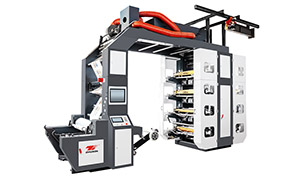
High Speed Flexo Printing Machine - Stack Flexo Flexo Printing Machine
The key advantage of stack presses is their ability to handle a wide range of substrate thicknesses (up to 12 mm for corrugated) because each deck's impression can be independently adjusted. This makes them ideal for post-print corrugated boxes, where the board is printed after fluting and lamination.
However, stack presses require more floor space and have longer web paths between decks, which can lead to registration challenges, especially at higher speeds. To mitigate this, modern stack presses incorporate servo-driven decks with automatic register control and web tension stabilizers.
Common applications include corrugated packaging (e.g., fruit boxes, shipping containers), folding cartons, paper bags, and heavy-duty sacks. They are also used for printing on solid board and multi-layer paperboards for food packaging and displays.
Maintenance for stack presses includes regular inspection of each deck's impression cylinder surface, cleaning of anilox rollers (which are often large and heavy), and checking the parallelism of cylinders to avoid uneven pressure. The open design makes these tasks more straightforward compared to CI presses, reducing maintenance downtime.
Economic factors: Stack presses have lower initial cost than CI presses of similar width, and their simplicity makes them easier to operate. They are a popular choice for medium-volume corrugated operations and for converters who frequently change substrate types and thicknesses, as the independent decks allow quick adjustments without affecting other colors.