flexo web guide
A flexo web guide (also called web steering or web alignment system) is a device that automatically corrects lateral position of the moving web as it travels through the press, ensuring that it remains centered or aligned to a specific edge throughout the printing and converting process. Proper web guiding is essential for maintaining register, preventing wrinkles, and ensuring even coating and cutting.
Web guides operate on the principle of detecting the web's position using sensors (optical, ultrasonic, or infrared) and then adjusting a pivoting roller or a pair of movable rollers to steer the web back to the desired reference. The response time and accuracy of the guide directly affect press stability, especially at high speeds (up to 600 m/min) and with thin, stretchable films.
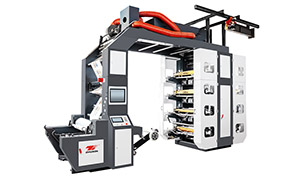
High Speed Flexo Printing Machine - Stack Flexo Flexo Printing Machine
There are three common guiding modes: edge guide (follows one edge of the web), center guide (keeps the web centered regardless of width changes), and line guide (follows a printed line or pre-printed mark). Edge guiding is most common for simple slit rolls, while center guiding is used when web width varies due to temperature or tension changes. Line guiding is employed for printing on pre-printed substrates or when precise lateral register is needed.
Sensor types: Optical sensors (LED or laser) are widely used for opaque substrates, detecting contrast between web and background. Ultrasonic sensors work for transparent films by measuring distance to the web surface. Infrared sensors are effective for dark or highly reflective materials. Modern systems often combine multiple sensors for redundant detection and noise filtering.
Actuators: The correction is performed by a steering frame that tilts a roller or by a pair of movable rollers that shift the web laterally. Servo motors with high-resolution encoders provide fast and precise adjustments. The actuator must be placed at the optimal location in the web path, typically after the unwind and before the first printing deck, as well as between decks for multi-color jobs.
Integration with tension control: Web guides are often linked with tension sensors to compensate for lateral shift caused by tension variations. In closed-loop systems, the guide controller receives tension data and adjusts steering accordingly, preventing edge wander that leads to wrinkles or web breaks. This integration is crucial for film printing where both tension and lateral position are critical.
Maintenance: Keep sensor windows clean using soft cloth and approved cleaner. Check actuator linkages for wear and lubrication. Calibrate the guide periodically using a test roll with known deviation. Replace worn rollers or bearings that cause friction. Ensure the guide's control software is updated for new substrate types. A well-maintained web guide reduces waste (by up to 30%), improves print register, and extends press life by reducing mechanical stress.