flexo vs gravure
Flexo (flexographic) and gravure (rotogravure) are the two dominant printing processes for high-volume packaging production. While both are rotary printing methods, they differ fundamentally in plate/cylinder construction, ink transfer mechanism, and economic viability across run lengths. Understanding these differences is critical for converters and brand owners when choosing the most suitable technology for their specific application.
Printing process: Flexo uses flexible photopolymer plates with raised relief image areas, and ink is metered via an anilox roller and doctor blade. Gravure uses engraved metal cylinders where cells hold ink, and excess ink is scraped off by a doctor blade before the cylinder contacts the substrate. Gravure applies ink from cells directly, while flexo transfers ink from anilox to plate to substrate. This gives gravure a smoother ink film and potentially higher resolution.
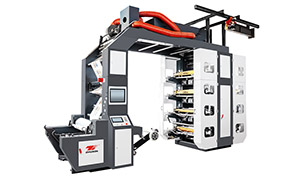
High Speed Flexo Printing Machine - Stack Flexo Flexo Printing Machine
Print quality: Gravure typically offers superior quality for fine details, smooth vignettes, and consistent solids, with minimal dot gain and sharper edges. Flexo has improved dramatically with HD plates, flat-top dots, and sleeve technology, but still shows more dot gain and grainy highlights. For photographic images on film, gravure is often preferred; for line art and text on paper or corrugated, flexo is fully acceptable.
Cost structure: Gravure cylinders are expensive to engrave (e.g., $500-$2000 per cylinder) and have long lead times, but are durable for millions of impressions. Flexo plates are cheaper (e.g., $50-$200 per plate) and faster to produce, but have shorter life (hundreds of thousands of impressions). Therefore, gravure is economical for extremely long runs (above 1 million meters), while flexo is cost-effective for short to medium runs (below 500,000 meters) and frequent job changes.
Speed and productivity: Both can reach high speeds (flexo up to 600 m/min, gravure up to 800 m/min). However, flexo has faster setup and changeover times (often under 15 minutes vs. 1-2 hours for gravure), making it more responsive to just-in-time production. Gravure excels in consistent quality over extremely long runs without plate wear.
Substrate compatibility: Flexo handles a wider range of substrates, including paper, board, film, foil, and nonwoven, and can print on both porous and non-porous surfaces with appropriate inks. Gravure is excellent for films, foil, and coated papers but is less suitable for heavy board or rough surfaces. Flexo also allows printing on thicker materials (corrugated up to 12 mm) that gravure cannot handle.
Environmental impact: Flexo uses water-based and UV inks with low or zero VOCs, making it more environmentally friendly. Gravure still predominantly uses solvent-based inks, though water-based gravure is emerging. Solvent recovery systems add cost. Flexo also has less ink waste due to closed doctor blade systems.
Decision criteria: Choose flexo if you have short-to-medium runs, frequent job changes, diverse substrates (including corrugated), and need fast turnaround. Choose gravure if you require the highest quality for photographic images, extremely long runs (over 1 million linear meters), and consistent high-volume production on films. In practice, many large printers operate both technologies, using gravure for premium work and flexo for versatility and cost efficiency. Hybrid presses combining both are also available for niche applications.