flexo unwind
The unwind station is the starting point of a flexo printing line, where the raw substrate roll is mounted and fed into the press. Its primary functions are to support the roll securely, provide controlled unwinding tension, and enable roll changes with minimal downtime. Proper unwind operation is essential to prevent web breaks, wrinkles, and tension-induced register errors.
Unwind configurations: Shafted unwinds use a through-axle (shaft) inserted into the roll core and clamped. Shaftless unwinds have chucks that grip the core from both ends without a full shaft, offering faster loading and accommodating various core diameters. Shaftless designs are becoming standard for wide-web and heavy rolls due to easier handling. Both types must maintain a constant web path angle to the first guide roller to avoid edge wander.
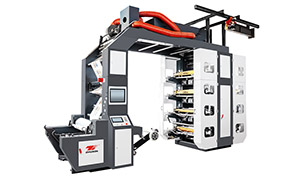
High Speed Flexo Printing Machine - Stack Flexo Flexo Printing Machine
Tension control: The unwind motor (usually AC servo with regenerative braking) maintains a consistent web tension by opposing the pull from the downstream printing decks. Load cells measure actual tension, and a dancer roller acts as a buffer to absorb short-term fluctuations. For thin films, tension is kept low (e.g., 0.2-0.5 N/cm width) to avoid stretching; for paper and board, tension is higher (1-2 N/cm). Taper tension (reducing tension as roll diameter decreases) compensates for the changing inertia and prevents slip between layers.
Splicing: To enable continuous production, unwinds are equipped with a splice table where the tail of the expiring roll is joined to the lead of a new roll. There are manual splices (operator applies tape) and automatic splicers that use double-sided tape and a cut-off knife, performing the splice at full speed without stopping. Automatic splicers are mandatory for high-speed lines and reduce waste significantly.
Roll handling: Heavy rolls (up to 2 tons) are loaded using a hoist, forklift, or roll loading trolley. The core chuck must engage securely to avoid slip. Some unwinds have a core brake to prevent over-speed when the web breaks. Core diameter compatibility (usually 3-inch or 6-inch) must be matched to the chuck design.
Web cleaning: An optional cleaning unit (with tacky rollers or ionized air) can be installed immediately after the unwind to remove dust and contaminants that would otherwise cause hickeys or plate damage. This is especially important for film and paperboard.
Maintenance: Inspect chucks and core grips for wear; replace if they cannot hold torque. Clean load cells and dancer roller pivot points. Lubricate bearings and guide rails. Calibrate tension sensors with a known weight. Check splices for consistent quality (tape adhesion, clean cut). A well-maintained unwind ensures smooth, tension-controlled web feed, which is the foundation of consistent flexo print quality and high uptime.