flexo substrate types
This wiki content systematically classifies mainstream flexo printing substrates, analyzes physical surface features, ink absorption characteristics and printing adaptation requirements of each material, and guides reasonable substrate matching for different flexo printing orders.
Flexo printing is famous for ultra-wide substrate adaptability compared with offset and gravure printing technologies, supporting printing on porous absorbent materials and smooth non-absorbent materials. All flexo printing substrates are divided into four major categories in the printing industry: paper substrates, plastic film substrates, paperboard substrates and nonwoven fabric substrates. Each category has unique surface energy, ink absorption rate, tensile strength and surface roughness, requiring targeted ink formulas, printing pressure and drying parameter settings.
The core difference among various flexo substrates lies in ink absorption mode and surface energy. Paper and cardboard are porous hydrophilic substrates with strong natural ink absorption capacity, which are compatible with common water-based flexo inks directly. Plastic films and nonwoven fabrics are non-porous hydrophobic materials with low surface tension, needing mandatory surface corona treatment before printing to achieve qualified ink adhesion effect.
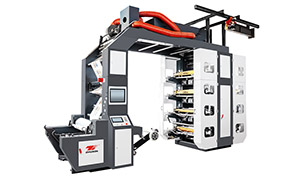
High Speed Flexo Printing Machine - Stack Flexo Flexo Printing Machine
Paper substrates are the most cost-effective and widely used flexo printing materials, including offset paper, label paper and kraft paper. These materials have loose fiber structures and natural micropores on surfaces, which can absorb water-based flexo ink rapidly without extra pretreatment. They are mainly applied to food outer packaging, commodity labels, paper bags and commercial printed matters. The main defect of paper substrates is easy moisture absorption and deformation under high-humidity production environments.
Plastic film substrates feature excellent tensile resistance, waterproof performance and transparency, suitable for flexible packaging fields. Common types include PE film, PP film, PET film and PVC film. These smooth non-absorbent films cannot absorb ink naturally, so corona treatment and low-surface-energy special flexo inks are necessary. Film substrates require lower printing pressure to avoid substrate stretching and pattern deformation during high-speed printing.
Paperboard substrates are thick rigid packaging materials including corrugated board, white cardboard and gray board, used for carton packaging and gift box outer surface printing. Due to thick thickness and hard texture, flexo printing on board needs higher printing pressure and softer photopolymer plates to fit uneven board surfaces. Meanwhile, dust cleaning devices must be equipped before printing to remove surface paper dust affecting printing clarity.
Nonwoven fabric substrates are breathable fiber materials with irregular loose surface structures, commonly used in medical supplies packaging, shopping bags and hygiene products. Their uneven surface brings challenges to uniform ink transfer, so operators need to increase ink coating thickness properly and adopt medium printing speed to guarantee complete and uniform pattern presentation.