flexo shrink sleeve
Flexo shrink sleeve printing produces full-body labels on heat-shrinkable films (typically PVC, PETG, OPS, or PLA) that are printed, seamed into a tube, and then placed over containers (bottles, cans, jars). Upon exposure to heat, the sleeve shrinks tightly around the container's contours, providing 360-degree decoration, tamper-evidence, and label protection.
The printing is done on flat film roll on CI flexo presses (6-10 colors, sometimes 12) with widths up to 1200 mm and speeds up to 400 m/min. The film is oriented (stretched) in one direction to ensure controlled shrinkage. Printing must be registered precisely to the shrinkage direction because artwork will distort during shrinking; software pre-distortion compensates for this.
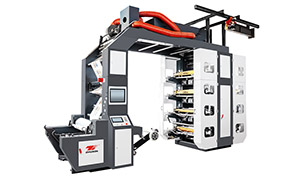
High Speed Flexo Printing Machine - Stack Flexo Flexo Printing Machine
Film types: PVC is low-cost but less recyclable; PETG offers high clarity and good shrinkage; OPS (oriented polystyrene) is eco-friendlier but more brittle; PLA is bio-based and compostable but has lower heat resistance. The choice affects ink adhesion, drying, and shrinkage ratio (typically 40-70% in the transverse direction, minimal in machine direction).
Inks: UV flexo inks are dominant because they cure instantly, avoid evaporation that could shrink film, and provide high gloss and chemical resistance. They must be flexible enough to withstand shrinkage without cracking or crazing. Low-migration UV inks are required for food and beverage contact. Some applications use solvent-based inks for excellent adhesion to PVC and OPS, but they require careful drying to avoid film distortion.
Printing challenges: The film's high static charge attracts dust; static eliminators are essential. Web tension must be minimal to avoid stretch, which would alter the shrinkage ratio. The register mark must be printed on each repeat to guide the seaming and cutting processes. The seam overlap (usually 2-5 mm) must be free of printing or have special adhesive-friendly coating.
After printing, the film is slit into individual sleeve widths, then seamed (using solvent or heat) into continuous tubing. The tubing is then cut to length and loaded onto containers via steam or hot air tunnels, which shrink the sleeve to fit the container body. Pre-distortion of graphics is calculated using simulation software to ensure artwork appears correctly after shrinkage.
Quality factors: Print contrast and opacity are important because the sleeve is translucent. White ink layer or backing is often used to prevent show-through of container contents. The sleeve must not shrink before application, so storage conditions (temperature, humidity) are controlled. Print defects like pinholes or streaks are unacceptable as they become magnified on the curved container surface.
Market: Shrink sleeves are widely used for beverages (sports drinks, beer), personal care (shampoo, lotion), and food (sauces, condiments). They offer premium shelf appeal and 360-degree branding. Flexo competes with gravure for long runs; however, flexo's faster setup and lower plate cost make it attractive for runs from 100,000 to 1 million sleeves. Hybrid flexo with digital print heads enables versioning and short-run customization. Sustainability pushes for recyclable sleeves (PETG and OPS being more recyclable than PVC) and water-based inks, but UV remains the norm due to performance. Flexo shrink sleeve printing continues to grow with innovations in low-temperature shrink films and high-speed seaming technology.