flexo rewind
The rewind unit is the final station of a flexo printing line where the printed and optionally converted web is wound into finished rolls for storage, shipment, or further converting. The quality of rewind directly affects downstream processing, as poorly wound rolls cause telescoping, blocking, or web breaks during subsequent operations like slitting or bag-making.
There are three main rewind types: surface winding (driven by a contact roller on the roll surface), center winding (driven by the roll core shaft), and turret winding (with multiple shafts for continuous operation). Surface winding is simpler and suitable for low-tension materials like paper; center winding allows better tension control for films; turret rewind enables automatic roll changeover without stopping the press, essential for high-speed lines.
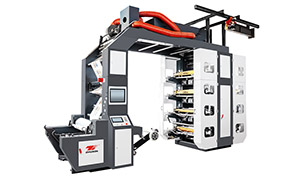
High Speed Flexo Printing Machine - Stack Flexo Flexo Printing Machine
Tension control at rewind is critical. As the roll diameter increases, the rotational speed must decrease to maintain constant linear tension. Modern rewinds use dancer rollers and load cells with PID controllers to adjust motor torque dynamically. For extensible films, a tapered tension profile (reducing tension as the roll builds) prevents crushing the inner layers and avoids "star" or "gusset" defects.
Roll hardness and density: The finished roll must have uniform hardness across the width and from core to outer layers. Too soft a roll can deform during handling; too hard causes stress on core and potential cracking. Hardness is measured with a durometer or via ultrasound. The rewind's nip pressure and winding tension are adjusted per substrate specifications.
Integration with slitting: Many rewinds are combined with slitting knives that slit the wide web into multiple narrow rolls. The slitting module is placed just before the rewind, and each slit strand is wound onto separate cores on the same rewind shaft (for center winding) or onto individual turret arms. Accurate slitting registration to printed patterns is achieved with edge guides and mark sensors.
Quality inspection at rewind: Inline cameras or scanners mounted near the rewind detect final defects (scratches, pinholes, color variation) and can automatically divert defective sections to a reject spool. Some systems include a roll inspection table that measures density uniformity and layer-to-layer adhesion.
Automation: Turret rewinds with automatic core loading, adhesive application, and roll push-off are standard in modern presses. They can handle roll diameters up to 1200 mm and widths up to 2800 mm. The rewind is synchronized with the press speed and any upstream processes (laminating, coating) via a central control system. Proper rewind maintenance includes cleaning drive rollers, lubricating bearings, calibrating tension sensors, and checking core chucks for wear. A reliable rewind ensures that the finished product meets shipping and customer quality standards, minimizing rework and returns.