flexo registration control
Flexo registration control is the technology that ensures all colors or process steps are precisely aligned in a multi-color flexo printing press. Accurate registration is essential for reproducing sharp images, preventing color fringing, and maintaining consistent print quality across long runs. Typical registration tolerance for high-quality flexo printing is ±0.05 mm to ±0.10 mm.
The control system relies on sensors that detect register marks (usually small targets printed at the edge or between images) on the moving web. Optical or camera-based sensors read these marks after each color deck. The signal is sent to a controller that compares the position against a reference and adjusts the plate cylinder position or web tension to correct any deviation.
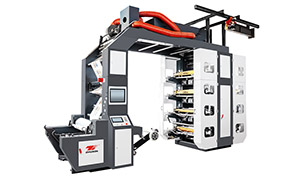
High Speed Flexo Printing Machine - Stack Flexo Flexo Printing Machine
Actuators for register correction include servo motors that rotate the plate cylinder forward or backward relative to the impression cylinder, or dancer rollers that adjust the web path length between decks. In modern presses, each deck has its own servo drive, allowing independent and rapid corrections. This closed-loop system operates continuously during printing, compensating for substrate stretch, thermal expansion, or mechanical play.
There are two types of register: longitudinal (print-to-print) along the web direction, and lateral (side-to-side) across the web width. Lateral registration often uses edge guide sensors or camera-based pattern recognition. Both axes are controlled simultaneously in advanced systems. Manual registration is possible but slower and less accurate, reserved for simpler jobs or obsolete presses.
Key parameters: register mark size, shape, and color contrast affect sensor readability. Typically, opaque marks on opaque substrates use contrasting colors; for transparent films, backlighting or special marks are needed. The sensor distance from the print nip and the response time of the controller determine the correction speed and accuracy.
Troubleshooting misregister: Common causes include web tension variations (adjust dancer rollers), roller wear (replace bearings), inconsistent substrate thickness (check unwind), or sensor drift (recalibrate). Also, temperature changes in the press environment can cause mechanical expansion; keep the press area climate-controlled. Electrical noise can affect sensors; ensure proper grounding and shielding.
Maintenance: Regularly clean register mark sensors with soft cloth and isopropyl alcohol. Check sensor alignment and mounting brackets. Calibrate the system using test patterns at least monthly. Verify actuator response times by performing test corrections. With proper setup and maintenance, flexo registration control ensures crisp, vibrant multi-color prints that meet the most demanding brand specifications, reducing waste and rework significantly.