flexo printing width
This page comprehensively explains flexo printing width, including mainstream width classifications, core influencing factors, matching press types and practical production applications. It also analyzes how printing width affects production cost, printing efficiency and product applicability in modern flexographic printing workshops.
Flexo printing width refers to the maximum effective horizontal dimension that a flexographic printing press can complete pattern transfer on printing substrates, which is one of the core hardware parameters determining the production capacity and application scope of flexo printing equipment. This parameter directly defines the maximum size of finished printed products and restricts the types of substrates that can be used in continuous roll-to-roll flexo production. All flexo printing presses are designed with fixed rated printing width, and operators cannot arbitrarily adjust the effective printing width beyond the mechanical limit of the equipment during operation.
According to industry unified classification standards, flexo printing width is divided into three mainstream specifications covering all production scenarios, namely narrow web, mid web and wide web flexo printing. Narrow web flexo printing usually has a width below 500mm, which is widely adopted for small-batch label printing, sticker production and small cosmetic packaging. Mid web flexo printing ranges from 500mm to 1270mm, fitting most daily flexible packaging such as food bags and plastic wrapping films. Wide web flexo printing covers widths above 1270mm, serving large-format packaging, corrugated board pre-printing and industrial roll material printing.
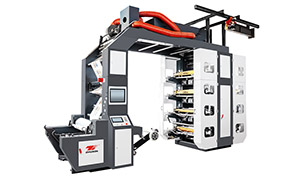
High Speed Flexo Printing Machine - Stack Flexo Flexo Printing Machine
Multiple internal and external factors determine the actual usable flexo printing width in addition to the rated equipment width. The first factor is the structure of the printing cylinder and central impression drum, as uneven drum surface or cylinder deformation will reduce the actual effective printing width. The second factor is the installation space of auxiliary components including doctor blades and anilox rollers, which will occupy partial edge printing area after assembly. Besides, substrate physical properties also play a role: thin and soft films are prone to edge warping, so operators need to reserve extra blank edges and narrow down the practical printing width properly.
Matching appropriate printing width with production demands is critical to control production cost and improve material utilization. Using an oversized wide web press for small-size label jobs will lead to serious substrate waste and increased energy consumption. In contrast, narrow web equipment cannot support large packaging production, resulting in production bottlenecks. Professional printing factories usually configure multiple flexo presses with different widths to cover diversified order demands from small personalized orders to mass large-format printing tasks.
With the upgrading of flexo printing manufacturing technology, modern flexo presses have realized partial adjustable printing width functions to enhance equipment flexibility. New servo-controlled flexo machines can adjust effective printing width within a certain range without replacing core rollers, which shortens order switching time and improves overall production efficiency. Nevertheless, the maximum mechanical width of the equipment still cannot be broken through to guarantee printing registration accuracy and machine operation stability in long-time continuous production.