flexo printing speed
This article introduces standard speed parameters of different flexo presses, analyzes mechanical and material factors restricting printing speed, and shares practical optimization schemes to balance printing speed and printing quality for flexographic printing manufacturers.
Flexo printing speed means the linear moving speed of roll substrates passing through each printing unit during continuous flexographic printing production, measured in meters per minute in international printing industry standards. It is a key indicator to evaluate the production efficiency of flexo printing lines and directly determines the daily output capacity of printing workshops. Different types of flexo presses have inherent rated speed ranges set by manufacturers based on mechanical structure, servo drive system and drying module configuration.
There are obvious speed differences among narrow web, mid web and wide web flexo printing devices. Ordinary narrow web label flexo presses can stably run at a speed of 150 to 300 meters per minute. Mid web packaging flexo presses support a speed range from 200 to 450 meters per minute. High-end wide web industrial flexo presses equipped with advanced hot air drying systems can reach a maximum stable printing speed of 600 meters per minute without quality defects.
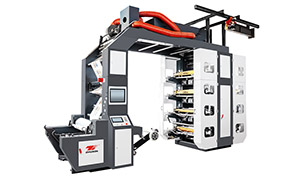
High Speed Flexo Printing Machine - Stack Flexo Flexo Printing Machine
Printing quality stability is the primary restriction for improving flexo printing speed. When the running speed exceeds the matching threshold of equipment, the ink transfer volume of anilox rollers will become unstable, causing uneven ink color on printed patterns. Meanwhile, ultra-high speed operation will aggravate substrate tension fluctuation, leading to printing register deviation between multiple color groups, which damages the integrity of color patterns. Fast running speed also reduces the drying time of water-based flexo ink, resulting in surface ink smudging and pattern adhesion during rolling and collection.
Mechanical performance and auxiliary system configuration are core hardware factors affecting flexo printing speed. Advanced full-servo drive systems realize synchronous operation of all printing units, supporting faster running speed while maintaining precise registration. Insufficient drying capacity is a common bottleneck for low-speed old flexo presses; upgrading infrared and hot air integrated drying modules can effectively improve the upper limit of safe printing speed. In addition, the wear degree of doctor blades and flexo plates will also affect the maximum stable running speed of the whole machine.
Reasonable speed matching strategies help manufacturers maximize economic benefits without sacrificing printing quality. For simple single-color or two-color text printing tasks, factories can adopt medium and high speed operation to boost output. For high-precision multi-color pattern printing with fine lines and gradient colors, production speed needs to be reduced appropriately to ensure accurate color registration and clear pattern restoration. Regular maintenance of transmission parts, tension control systems and ink circulation systems can also maintain long-term high-speed stable operation of flexo printing equipment.