flexo printing production line
A flexo printing production line (or converting line) is an integrated system that combines flexo printing with subsequent converting processes such as coating, lamination, die-cutting, slitting, and stacking, all in a single continuous web path. This end-to-end solution reduces handling, labor, and waste, while improving production speed and quality consistency for packaging and label manufacturing.
The production line typically begins with an unwind station, followed by optional pre-treatment (corona, primer coating), then multiple flexo printing decks (usually 4-10 colors), interstation dryers or UV curing units, additional stations for cold foil, varnish, or lamination, a die-cutting or rotary cutting unit, a slitting section, and finally a rewind or sheeting/stacking unit. Every component is synchronized by a central control system that manages speed, tension, register, and quality parameters.
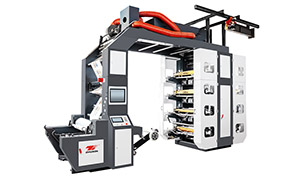
High Speed Flexo Printing Machine - Stack Flexo Flexo Printing Machine
Key components: 1) Unwind – with automatic splice for continuous running. 2) Corona treater – for film surface activation. 3) Printing decks – each with anilox, doctor blade, plate cylinder, impression cylinder, and dryer. 4) Interstation dryers (hot air, IR, UV) – to cure between colors. 5) Optional converting units – laminator, cold foil applicator, screen printing station. 6) Die-cutting – rotary or flatbed for shaping. 7) Slitting – for multiple lanes. 8) Rewind or stacking – for finished rolls or cut sheets. 9) Inspection system – with cameras and spectrometers.
Automation: Modern lines feature fully automated setup (job recipes stored in PLC), automatic impression setting, register control (closed-loop), and pressure adjustment. Some lines include AI-based defect detection that can automatically reject waste or adjust parameters. Quick-change sleeve and anilox systems reduce changeover time to under 10 minutes, enabling short-run profitability.
Workflow optimization: The line is designed to minimize web path length to reduce tension instability and stretching. All drives are servo-based with shared Ethernet communication for precise synchronization. The control system monitors web tension at multiple points and adjusts accordingly. Drying and curing are modulated in real-time based on press speed and ink coverage.
Quality management: Inline color management (spectrophotometer) adjusts ink feed to maintain ΔE within 1.0. Web inspection (print defect detection) identifies hickeys, streaks, and register errors, triggering alarms or automatically marking defective areas for later removal. The data is logged for traceability and process improvement.
Maintenance: The production line requires a comprehensive maintenance schedule: daily cleaning of anilox and plates; weekly lubrication of all moving parts; monthly calibration of sensors; quarterly gearbox oil changes; annual replacement of wear parts (doctor blades, bearings). Predictive maintenance using vibration sensors and thermal imaging is increasingly employed to prevent unplanned downtime.
Economic and production benefits: A well-integrated line can run at speeds up to 600 m/min with waste below 2%, producing finished rolls ready for shipping. It eliminates intermediate handling, reduces floor space, and lowers labor costs. For flexible packaging, folding carton, and label converters, investing in a flexo production line is a strategic decision that balances capital cost with long-term operational efficiency, enabling fast response to market demand and high-quality output for brand owners.