flexo printing on paper
This content introduces process parameters, advantages, common defects and optimization methods of flexo printing on various paper materials, covering label paper, kraft paper and coated paper printing scenarios for packaging and label industries.
Flexo printing on paper is the most mature and cost-friendly flexo printing application scenario, covering self-adhesive labels, kraft paper bags, paper packaging boxes and commercial paper printed products. Paper is a typical porous hydrophilic substrate with natural fiber gaps on the surface, which can automatically absorb water-based flexo ink without complex surface pretreatment, greatly simplifying the overall printing process and reducing production costs.
Different types of paper substrates have different ink absorption speeds, requiring differentiated flexo press parameter adjustment. Uncoated plain paper has large surface fiber gaps and fast ink absorption speed, while coated paper has smooth compact surface and relatively slow ink absorption speed. Blind unified parameter setting will cause uneven color density and shallow pattern tone on different paper materials.
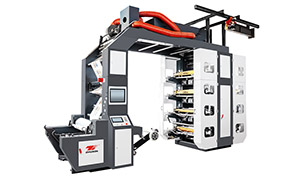
High Speed Flexo Printing Machine - Stack Flexo Flexo Printing Machine
Printing pressure matching is a key point for high-quality flexo printing on paper. Paper has moderate hardness and certain compression resilience. Excessive printing pressure will squeeze ink into deep fiber gaps, causing fuzzy pattern edges and penetrated ink on paper backside. Too small pressure leads to insufficient ink transfer and faint printed patterns. Medium and stable printing pressure is always the optimal choice for most paper printing orders.
Water-based flexo ink is the exclusive matched ink type for paper flexo printing due to environmental protection requirement and good absorption compatibility. Water-based ink can penetrate paper fiber gaps steadily and form firm binding force after air drying. Compared with solvent-based ink, water-based ink has no harmful volatile gas, meeting environmental protection standards for food paper packaging and children paper products.
Common quality defects of flexo printing on paper include ink penetration, color unevenness and paper wrinkling. Ink penetration usually happens on thin uncoated paper, solved by properly lowering anilox roller ink volume. Color unevenness results from uneven paper surface fiber density, which can be improved by stabilizing ink viscosity. Paper wrinkling is caused by mismatched web tension, requiring real-time tension fine adjustment during machine operation.
Flexo printing on paper has prominent production advantages compared with other printing processes. It supports low-cost short-run orders, fast order switching and low equipment maintenance cost. With continuous process upgrading, modern paper flexo printing can achieve high-definition fine text and gradient dot printing effects, gradually replacing traditional offset printing in medium and small batch paper packaging and label markets.