flexo printing on nonwoven
This document analyzes the structural characteristics of nonwoven substrates, lists printing challenges, and provides targeted parameter adjustment schemes for flexo printing on nonwoven fabrics used in medical, hygiene and packaging industries.
Flexo printing on nonwoven is a professional flexo printing process applied to irregular fiber nonwoven fabric substrates, widely used in medical surgical mask packaging, disposable hygiene products, environmental protection nonwoven shopping bags and agricultural nonwoven coverings. Nonwoven fabrics are composed of disorderly stacked fibers without compact smooth surface, whose porous, uneven and breathable structure brings unique challenges to conventional flexo printing processes.
The biggest difficulty of flexo printing on nonwoven fabrics is unstable ink transfer caused by irregular surface structure. Unlike film and paper with flat surfaces, nonwoven materials have concave and convex fiber gaps all over the surface. Conventional fixed ink transfer parameters will lead to partial ink shortage on raised fibers and ink accumulation in sunken gaps, resulting in fuzzy and uneven printed patterns.
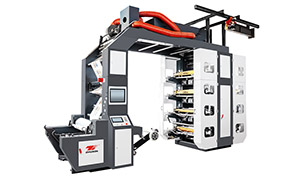
High Speed Flexo Printing Machine - Stack Flexo Flexo Printing Machine
Reasonable matching of anilox roller parameters is the core solution for nonwoven flexo printing. Compared with paper and film printing, nonwoven production needs anilox rollers with larger cell volume and lower line count to increase single ink transfer amount. Extra ink can fill fiber gaps fully and form continuous complete ink layers on the uneven fabric surface, ensuring clear and integrated printed patterns without missing points.
Printing speed and tension control need special optimization for elastic nonwoven substrates. Most nonwoven fabrics have certain longitudinal elasticity and are easy to deform under strong traction force. Operators need to lower continuous printing speed moderately and reduce web tension compared with film printing, avoiding fabric stretching, shrinkage and pattern distortion during high-speed operation.
Ink type selection follows breathability matching principle for nonwoven printing. Thick ink layers will block fabric micropores and damage original air permeability of nonwoven products. Water-based soft flexo inks with good air permeability are the best choice, which can form thin and firm ink films without blocking fiber gaps. Meanwhile, proper corona treatment is still required to improve ink adhesion on smooth synthetic fiber nonwoven surfaces.
Common defects and corresponding fixes for nonwoven flexo printing include fuzzy patterns, ink penetration and fabric deformation. Fuzzy patterns are solved by increasing ink transfer volume and reducing printing speed. Excessive ink penetration into fabric bottom is improved by lowering printing pressure. Fabric tensile deformation can be controlled by optimizing tension system parameters and adopting segmented tension adjustment mode for front and rear printing units.