flexo printing on film
This guide focuses on technical difficulties, parameter settings, pretreatment processes and quality control skills of flexo printing on various plastic films, solving common film printing defects such as ink peeling and pattern stretching.
Flexo printing on film refers to flexographic pattern transfer on smooth non-absorbent plastic film materials including PE, PP, PET and BOPP films, which is the mainstream process for food flexible packaging, daily chemical packaging and plastic roll film printing. Different from porous paper materials, plastic films have closed smooth surfaces without ink absorption pores, bringing unique technical challenges for ink adhesion, drying control and tension stability during printing production.
Surface corona pretreatment is an indispensable core process before flexo printing on all plastic films. Original plastic film has extremely low surface tension, making flexo ink hard to wet and attach to the surface. Standard corona treatment can raise film surface tension to 38-42 dyn, forming uniform micro rough structures to enhance ink wetting performance and long-term adhesion durability.
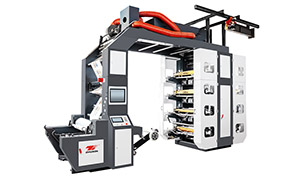
High Speed Flexo Printing Machine - Stack Flexo Flexo Printing Machine
Precise tension control is vital to avoid pattern stretching and registration errors during film flexo printing. Plastic films have strong ductility and are easy to stretch under excessive traction force, leading to elongated printed patterns and accumulated color registration deviation. Modern film flexo presses adopt full closed-loop tension control systems to keep constant web tension all the time, adapting to high-speed continuous printing without substrate deformation.
Ink and drying parameter matching is specially designed for film flexo printing. Water-based flexo inks are most commonly used for food packaging films, but longer hot air drying time is required as films cannot absorb water in ink. UV curing flexo inks are preferred for high-speed film printing thanks to instant curing performance without substrate thermal deformation. Operators need to reduce anilox roller ink volume properly to prevent ink overflow and pattern blurring on smooth film surfaces.
Common defects of flexo printing on film include ink peeling, pattern stretching, ink back sticking and moire patterns. Ink peeling is solved by enhancing corona power and checking corona equipment aging regularly. Pattern stretching is eliminated by optimizing tension parameters and reducing unnecessary printing pressure. Ink back sticking after rolling is improved by extending drying time or switching to fast-curing UV flexo ink.
Special operational notes should be followed during film flexo printing production. Operators need to avoid static electricity accumulation by installing static elimination devices, as static electricity will attract dust and cause tiny white spots on printed films. Meanwhile, temperature and humidity in the printing workshop should be kept stable, because ambient humidity fluctuation will affect corona treatment effect and final ink adhesion performance of plastic films.