flexo printing on board
This wiki overview explains process difficulties, pressure settings, plate selection and dust removal solutions for flexo printing on thick rigid paperboard, adapting to corrugated carton and rigid packaging printing production demands.
Flexo printing on board refers to flexographic printing on thick rigid paper-based substrates including white cardboard, gray board and corrugated board, mainly used for outer carton packaging, commodity rigid boxes and logistics packaging printing. Different from thin flexible paper and film substrates, paperboard features high hardness, thick thickness, poor flexibility and uneven surface structure, which puts forward special requirements for printing pressure, printing plate hardness and machine structure design.
Printing plate hardness selection is the primary parameter for successful flexo printing on board. Hard printing plates cannot fit concave and convex uneven surfaces of corrugated board completely, leading to partial missing patterns. Therefore, soft shore A photopolymer flexo plates are specially matched for board printing to improve surface fitting performance and ensure complete ink transfer on rough board surfaces.
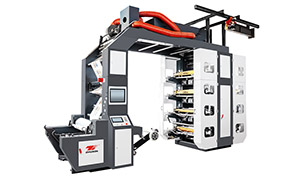
High Speed Flexo Printing Machine - Stack Flexo Flexo Printing Machine
High and stable printing pressure is required for flexo printing on rigid paperboard. Due to hard texture and strong compression resistance of board materials, standard printing pressure for thin paper is insufficient to realize effective ink transfer. Operators need to increase overall printing cylinder pressure properly while keeping pressure uniform across the whole printing width to avoid partial shallow printing problems.
Surface dust removal is a necessary pre-printing procedure for board flexo printing. Cutting and molding processes will produce plenty of paper dust and fiber debris on paperboard surfaces. These impurities will block anilox roller cells, damage printing plates and form white spot defects on finished printed products. Online vacuum dust removal systems are essential equipment installed on board flexo printing presses to clean surface impurities completely before ink transfer.
Ink selection and drying process are also optimized for board printing. Thick paperboard has poor air permeability and slow internal heat conduction, so high-power hot air drying systems are equipped to accelerate ink surface curing. For rough corrugated board, high ink volume anilox rollers are adopted to increase ink coating thickness and cover uneven board surface perfectly, ensuring uniform and full color presentation.
Common defects of flexo printing on board include partial pattern missing, uneven color and plate indentation. Pattern missing is solved by using softer printing plates and raising printing pressure. Uneven color is improved by strengthening dust removal effect. Plate indentation caused by excessive pressure can be avoided by testing pressure parameters with sample boards before formal mass production.