flexo printing defects
This article classifies typical flexo printing visual defects, analyzes mechanical, material and operational inducements one by one, and lists targeted repair schemes to help printing factories eliminate surface pattern flaws and upgrade finished product quality.
Flexo printing defects are visible abnormal pattern flaws appearing on printed substrates after ink transfer, which directly reduce finished product qualification rate and increase raw material loss. Unlike offset printing defects, flexo flaws are closely related to flexible plate compression deformation, quantitative ink transfer of anilox rollers and continuous web tension changes. All flexo printing defects can be classified into surface texture defects, dimensional deviation defects, ink density defects and edge pattern defects for unified analysis and processing.
Dot gain is one of the most common flexo printing defects, especially harmful for high-definition label and packaging printing. It means halftone dots on printed patterns expand larger than original design size, leading to dark color tone, blurred gradient transition and lost fine text details. Excessive printing pressure, too high anilox roller ink volume and soft printing plate hardness are three main direct causes of dot gain in actual production.
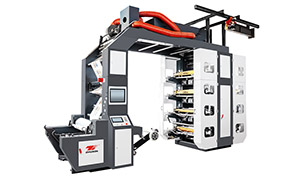
High Speed Flexo Printing Machine - Stack Flexo Flexo Printing Machine
Linear streak defects including horizontal and vertical streaks frequently occur in long-time high-speed flexo production. Vertical streaks along the web moving direction are mainly caused by tiny scratches on anilox roller surfaces or residual dry ink blocking partial roller cells. Horizontal periodic streaks are usually triggered by printing cylinder eccentricity, unstable servo motor operation or periodic doctor blade vibration. Different streak directions correspond to completely different maintenance and adjustment methods.
Other typical flexo printing defects include ink spitting, ghosting and pattern missing. Ink spitting refers to sudden excess ink splashing on substrates, resulting from mismatched doctor blade pressure and unstable ink chamber sealing. Ghosting means faint repeated shadow patterns beside official printed patterns, caused by incomplete ink drying and secondary contact between printed web and printing rollers. Pattern missing usually comes from damaged printing plate relief or blocked anilox cells without regular cleaning.
Most flexo printing defects are not caused by single factors but combined parameter mismatches. For example, fuzzy pattern edges are related to both excessive printing pressure and unsuitable ink viscosity. Operators cannot solve defects by adjusting only one single parameter. It is necessary to check ink system, pressure setting, component status and substrate performance comprehensively.
Establishing defect prevention standard operation procedures is more efficient than post-fault repair. Matching appropriate anilox roller line count according to pattern complexity, keeping stable constant machine tension, maintaining standard ink viscosity range and replacing vulnerable parts regularly can effectively avoid over 85% of conventional flexo printing defects in daily workshop production.