flexo printing accuracy
Flexo printing accuracy refers to the degree to which the printed image reproduces the intended design in terms of position, size, and color consistency. It encompasses register accuracy (color-to-color alignment), repeat length consistency, dot gain (dot growth), and dimensional stability of the printed pattern. High accuracy is critical for applications like barcodes, fine text, packaging with registration to cutting or lamination, and multi-panel designs.
Accuracy is typically measured using test forms with targets, vernier scales, and spectrophotometers. Register accuracy is quantified as the deviation in microns between the ideal and actual position of color separations. Repeat length accuracy (often called "print length" or "cylinder circumference") must be maintained within ±0.2 mm over thousands of impressions to ensure proper fit on subsequent converting operations. Dot gain is measured as the percentage increase in dot area from plate to print, affecting tone reproduction.
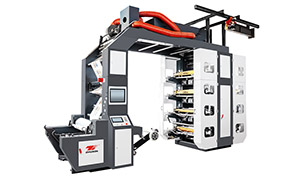
High Speed Flexo Printing Machine - Stack Flexo Flexo Printing Machine
Key factors influencing accuracy: 1) Plate mounting and stability – plates must be mounted with zero stretch and consistent tension; sleeve technology improves repeatability. 2) Anilox roller condition – worn cells cause ink volume variation, affecting color and dot size. 3) Substrate stretch – extensible films change length under tension, requiring dynamic register compensation. 4) Impression pressure – excessive pressure deforms the plate and increases dot gain; too little causes uneven transfer. 5) Press mechanical condition – backlash in gears, bearings, and cylinders creates cumulative errors.
Measurement methods: For register, use high-speed cameras with strobe lights to capture images of register marks; software calculates deviations in real-time and feeds back to servo drives. For repeat length, a high-resolution encoder on the impression cylinder tracks distance, and a mark sensor confirms actual position. Dot gain is measured with a densitometer or spectrophotometer using control strips printed alongside the job.
Strategies to improve accuracy: Use automated register control with predictive algorithms that anticipate substrate stretch based on speed and tension. Implement sleeve plate technology with uniform wall thickness to reduce cylinder run-out. Maintain consistent ink viscosity to avoid variations in film thickness. Ensure press warm-up before production to stabilize thermal expansion. Perform regular calibration of all sensors and drives.
Typical accuracy benchmarks: For high-end label printing, register within ±0.05 mm, repeat length tolerance ±0.15 mm, dot gain variation less than 3% across the run. For corrugated post-print, looser tolerances (±0.2 mm register, ±0.5 mm repeat) are acceptable. Advanced presses with AI-assisted controls can achieve near-digital accuracy, making flexo increasingly competitive with gravure and offset in high-quality segments.