flexo print quality
Flexo print quality encompasses a set of attributes including color density and uniformity, dot sharpness, tonal reproduction (highlights, midtones, shadows), minimum dot size, edge definition (mottle-free solids), and absence of defects such as hickeys, streaks, or ghosting. Achieving high quality in flexo requires careful optimization of every process parameter, from plate design to press settings and substrate preparation.
Critical quality metrics: Optical density (typically 1.3-1.8 for process colors), print contrast (ratio of density in solids vs. shadows), dot gain (ISO 12647-6 targets for flexo), and L*a*b* color accuracy. For line work, minimum reproducible line width (e.g., 0.1 mm) and smoothness of edges are important. Subjective evaluation includes visual gloss, evenness of large solid areas, and absence of visible banding.
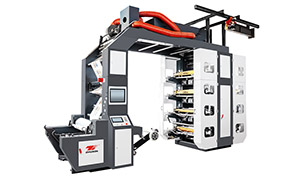
High Speed Flexo Printing Machine - Stack Flexo Flexo Printing Machine
Common defects and causes: Dot bridging (excessive dot gain) – reduce anilox volume or impression pressure. Pinholing (tiny unprinted spots) – increase ink viscosity or improve substrate wetting. Orange peel (uneven solid appearance) – use higher anilox line screen or adjust doctor blade angle. Ghosting (faint repeating patterns) – check for anilox cell blockage or worn bearings. Streaks – clean doctor blade or replace worn blade. Hickeys – improve ink filtration or clean substrate surface.
Quality control tools: Inline densitometers and spectrophotometers measure color and density at production speed, triggering adjustments when deviations exceed set limits. Web inspection cameras with artificial intelligence can detect and classify defects in real-time, alerting operators or automatically rejecting waste. Offline devices like tensiometers (for surface energy) and profilometers (for anilox cell depth) are used for preventive checks.
Best practices for quality improvement: Use high-quality photopolymer plates with flat top dots to improve ink transfer and reduce dot gain. Match anilox line screen to the required detail – finer lines for highlights, coarser for solids. Maintain ink temperature and viscosity within narrow ranges using automatic control. Ensure substrate surface energy is adequate (≥38 dynes/cm for films). Optimize drying to avoid excessive heat that can cause substrate distortion.
Operator training is essential – skilled operators can detect subtle quality changes by visual and tactile inspection. Implement standard operating procedures (SOPs) for setup, cleaning, and troubleshooting. Regularly audit quality using standardized test forms and compare against industry benchmarks (e.g., FTA First 3.0). By systematically addressing each factor, converters can achieve flexo print quality that rivals offset and gravure, meeting the most demanding customer expectations for packaging and labels.