flexo plate
This overview elaborates classification, performance parameters, installation requirements and service life characteristics of flexo plates, and analyzes the influence of plate hardness and thickness on final flexo printing effects.
A flexo plate is a flexible elastic printing carrier used to carry designed printing patterns in flexographic printing machines. Different from rigid metal plates used in offset printing and gravure printing, flexo plates have excellent bending resilience, which can fit the surface of circular printing cylinders perfectly during high-speed rotation operation. The raised patterns on the plate surface contact with ink transferred by anilox roller and complete pattern transfer onto substrates directly, which constitutes the most basic printing principle of flexographic technology.
Flexo plates can be classified into rubber flexo plates and photosensitive polymer flexo plates according to raw materials. Traditional rubber flexo plates have low manufacturing cost and strong wear resistance, but they have poor pattern reduction ability and cannot restore ultra-fine halftone dots and tiny lines. They are mostly used for simple packaging printing with low pattern precision requirements.
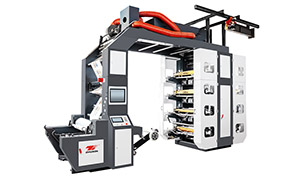
High Speed Flexo Printing Machine - Stack Flexo Flexo Printing Machine
Plate hardness and plate thickness are two core performance parameters affecting printing results. Hardness of flexo plates is measured by Shore hardness unit. Soft flexo plates with low Shore hardness are suitable for uneven and rough substrates such as corrugated cardboard, which can fit uneven substrate surfaces fully. Harder flexo plates are applied to smooth plastic films and coated paper, ensuring clear edge restoration of fine patterns without pattern extrusion deformation.
The quality of flexo plate mounting process greatly affects printing registration accuracy. Operators need to paste flexo plates on printing cylinders with special double-sided adhesive tape, and eliminate all bubbles between plate body and cylinder surface completely. Residual bubbles will cause local plate bulge, leading to partial unclear printing patterns. Meanwhile, the splicing gap between multiple plates on the same cylinder must be controlled within a tiny range to avoid obvious blank lines on continuous printed patterns.
The service life of flexo plates is determined by material performance, printing speed and ink corrosion resistance. Ordinary rubber flexo plates can support about 500,000 meters of continuous printing production, while high-grade photopolymer flexo plates can reach more than 1.2 million meters. Long-term erosion of water-based and solvent-based ink will gradually age the plate surface patterns, causing edge passivation. Timely plate cleaning and avoiding long-time idle contact between plates and ink can effectively prolong the usable cycle of flexo plates.