flexo ink
This article summarizes classification, performance characteristics, applicable substrates and daily viscosity adjustment methods of mainstream flexo inks, and explains the matching rules between different flexo inks and printing plates as well as anilox rollers.
Flexo ink is a special low-viscosity fluid ink independently developed for the flexographic printing process, which is different from high-viscosity thick ink used in offset printing. Combined with the quantitative ink transfer mode of anilox rollers, flexo ink maintains stable fluidity under high-speed roller rotation conditions to realize uniform ink output. Its low viscosity design matches the elastic contact printing mode of flexible flexo plates, avoiding pattern extrusion and ink accumulation during printing.
According to solvent components and curing methods, flexo inks are divided into three mainstream categories: water-based flexo ink, solvent-based flexo ink and UV curing flexo ink. Each type has unique environmental protection performance, drying principle and applicable production scenarios, meeting different environmental protection standards and substrate matching demands in global printing industry.
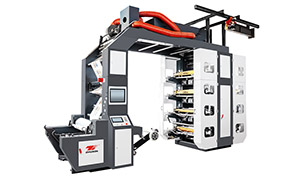
High Speed Flexo Printing Machine - Stack Flexo Flexo Printing Machine
Water-based flexo ink takes pure water as the main diluent, featuring low VOC emission, non-toxic and harmless characteristics, which is the most environmentally friendly flexo ink product. It relies on hot air evaporation to complete surface drying, and is widely used in food packaging, medical packaging and children's product printing fields with strict safety requirements. Its disadvantage is slow drying speed, so it needs to be equipped with high-power drying systems on high-speed flexo presses.
Solvent-based flexo ink adopts organic solvent as diluent with fast natural drying speed, which can adapt to ultra-high speed continuous flexo printing without auxiliary drying equipment. It has strong adhesion on difficult-to-stick substrates such as PE and PP plastic films. However, high VOC volatilization limits its application in food contact packaging, and waste gas treatment equipment must be equipped in production workshops to meet environmental protection emission standards.
UV flexo ink is cured instantly through ultraviolet irradiation without relying on solvent evaporation. It has zero VOC emission, ultra-fast curing speed and no substrate shrinkage after printing. This ink is suitable for heat-sensitive film substrates that cannot bear high-temperature drying. Although the overall procurement cost of UV ink and supporting UV lamp equipment is higher, it has become the preferred ink solution for high-efficiency and low-carbon modern flexo printing factories due to its comprehensive production advantages. In actual production, operators need to adjust ink viscosity in real time according to printing speed, anilox roller line number and ambient temperature to ensure consistent ink transfer effect all day long.