flexo folding carton
Flexo folding carton printing is the process of applying graphics onto paperboard (solid bleached sulfate SBS, coated unbleached kraft CUK, or recycled board) that will be die-cut and folded into cartons for products like cereals, cosmetics, pharmaceuticals, frozen foods, and electronics. Flexo offers high productivity, low cost, and excellent reproduction on board surfaces, competing with offset lithography and gravure.
There are two production modes: pre-print (printing on roll-fed board before die-cutting) and sheet-fed (printing on cut sheets). Pre-print uses CI or stack flexo presses with widths up to 2000 mm and speeds up to 350 m/min. Sheet-fed flexo (often using planetary or single-pass presses) processes individual board sheets, allowing easier handling and higher quality finishes, but at lower speeds. Most high-volume carton plants use pre-print for efficiency, while short-run specialty jobs may use sheet-fed.
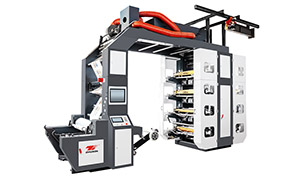
High Speed Flexo Printing Machine - Stack Flexo Flexo Printing Machine
Board characteristics: Folding carton board has a smooth, coated surface that can hold fine halftones (up to 150 lpi). It is stiffer than film but more porous than plastic, allowing water-based inks to dry by absorption and evaporation. For high-gloss or barrier requirements, UV inks and coatings are applied. The board must be moisture-stable to avoid warping after printing and drying.
Ink systems: Water-based inks dominate due to their low odor, FDA compliance for food contact, and easy cleanup. They require drying systems with hot air and IR to evaporate water, especially on heavy coverage. UV inks are used for premium cartons requiring high gloss, scratch resistance, and fast curing. Solvent-based inks are rare in carton printing due to residual solvents and environmental regulations. High-performance coatings like varnish, matte, or spot UV are often applied inline to enhance the final appearance and protection.
Die-cutting and creasing are typically done inline or offline. Rotary die-cutting with magnetic or solid dies is common for pre-print, while sheet-fed operations use platen die-cutters. Creasing ensures clean folding without cracking the board. The registration between print and die-cut must be tight, usually within ±0.2 mm. Some presses include in-line blanking and stacking of finished carton blanks.
Quality parameters: Print density, dot gain, and color consistency are measured. The board's surface roughness affects dot shape; smooth boards yield sharper dots. Coating coverage must be uniform to avoid mottle or orange peel. Drying conditions must not overheat the board to prevent blistering or delamination.
Cost and lead time: Flexo plates are cheaper and faster to produce than gravure cylinders, making flexo economical for runs from 50,000 to 500,000 cartons. Changeover time is under 30 minutes, allowing responsiveness to promotions. Compared to offset, flexo offers lower plate cost and easier inline converting, but offset may provide slightly better quality for very fine screens (above 175 lpi). Many converters choose flexo for its balanced cost-quality ratio, especially for packaging where speed and efficiency are paramount.