flexo flexible packaging
Flexo flexible packaging refers to the use of flexographic printing on flexible materials such as plastic films (PE, PP, PET, PA, BOPP), metallized films, paper, and foil laminates, which are later converted into pouches, bags, wrappers, and sachets. This segment is the largest application of flexo printing, driven by the growth of consumer packaged goods requiring attractive, functional, and barrier-protective packaging.
The printing is predominantly done on CI (central impression) flexo presses because they offer superior register accuracy on stretchable films. CI presses have a large common impression drum that holds the web firmly, eliminating slip between colors. Typical configurations are 6 to 10 colors, with widths from 600 mm to 1800 mm and speeds up to 500 m/min. For very wide webs (over 2000 mm), stack presses may be used but with less precision.
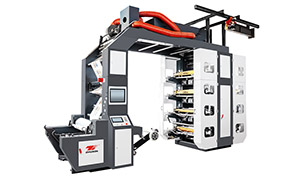
High Speed Flexo Printing Machine - Stack Flexo Flexo Printing Machine
Ink selection depends on the final application: solvent-based inks are still common for high-barrier films and excellent adhesion, though they require solvent recovery. Water-based inks are gaining ground for paper and some films, but drying is slower. UV inks are used for shrink sleeves and labels but less so for food pouches due to migration concerns. New developments include low-migration UV and EB-curable inks for food-contact compliance. Inline lamination stations can apply adhesive and combine layers, creating multi-layer structures with specific barrier properties (oxygen, moisture, aroma).
Drying is critical for film printing. Since films are non-porous, all solvents must be evaporated by hot air dryers interstation. The drying energy is high, and the temperature must be controlled to prevent film distortion. CI presses often have sophisticated dryer systems with air impingement and temperature zoning. Some use IR pre-heaters to increase efficiency. Solvent-based inks require careful ventilation and oxidation of exhaust gases.
Substrate handling: Films are lightweight and prone to stretching and wrinkling. Tension control systems with dancer rollers and feedback sensors maintain constant web tension from unwind to rewind. Corona treatment is often applied inline to increase surface energy for better ink adhesion. For metallized films, special primers may be needed. Static elimination devices prevent dust attraction and shocks.
Quality control for flexible packaging includes register accuracy (critical for multi-color graphics and registration to zipper, spout, or perforations), color consistency, and barrier integrity. Inline spectrometers and cameras detect defects. Printed rolls are then laminated to sealant films (e.g., LLDPE) using solvent-less or solvent-based adhesives, forming the final pouches. Converting processes like slitting and bag-making are often done offline, but some inline presses include slitting and rewinding units.
Trends: Sustainability drives the use of mono-material films (e.g., MDO-PE) that are fully recyclable, requiring adaptation of ink and printing processes. Digital and hybrid flexo are growing for shorter runs and variable data. Nano-barrier coatings and high-barrier water-based coatings are emerging. Flexo flexible packaging remains the cost-effective, high-speed choice for everything from snack bags to medical pouches, with continuous improvements in print quality and environmental footprint.