flexo drying tunnel
A flexo drying tunnel (also called an interstation or end-of-press dryer) is an enclosed chamber where hot air is blown onto the printed web to evaporate solvents or water from the ink film. It is essential for water-based and solvent-based flexo inks, as complete drying prevents smearing, set-off, and poor adhesion in subsequent processing.
The drying tunnel consists of a series of air nozzles (often of the slot or perforated plate type) that impinge high-velocity air onto the web. The air is heated by electric heaters, steam coils, or gas burners to temperatures typically ranging from 40°C for heat-sensitive films up to 150°C for paper and board. The air is then exhausted, carrying evaporated solvents, and may be partially recirculated to save energy.
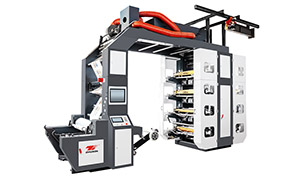
High Speed Flexo Printing Machine - Stack Flexo Flexo Printing Machine
Design parameters: Air velocity at the nozzle exit is critical; typical values are 10-30 m/s. Higher velocity increases the heat transfer coefficient and evaporation rate, but can cause web flutter if not carefully directed. The nozzle-to-web distance is optimized to maximize impingement effect while maintaining uniform drying across the width. Some tunnels use multiple passes (web meandering) to increase residence time without increasing tunnel length.
Temperature control: Each drying zone (usually 2-4 zones per tunnel) has independent temperature and airflow settings. The temperature profile is set to avoid overheating the substrate; for films, the first zone is cooler to gradually evaporate solvents, while later zones are hotter for complete drying. Sensors (thermocouples, IR) monitor web temperature to prevent degradation.
Energy efficiency: Recirculation of hot air reduces fuel consumption, but the recirculated air must be filtered to remove ink particles and dust. Heat recovery systems (e.g., heat exchangers) preheat incoming fresh air. Modern tunnels use variable frequency drives on fans to adjust airflow based on press speed and ink coverage, saving up to 30% energy compared to fixed-speed systems.
Integration with press speed: The drying capacity must match the maximum press speed and ink film thickness. The tunnel length and air temperature are designed such that the required drying time is achieved at the target speed. For heavy coverage, slower speed or additional IR boosters may be needed. The control system automatically adjusts drying parameters when press speed changes to maintain consistent dryness.
Troubleshooting: Insufficient drying results in smearing, set-off on rollers, or odor. Solutions: increase temperature, reduce speed, improve air flow (clean nozzles), or add an IR pre-heater. Over-drying can cause substrate shrinkage, curling, or brittleness; reduce temperature or increase web cooling after the tunnel. Also, check for uneven airflow across width causing differential drying; clean or adjust nozzles. Regular maintenance includes cleaning nozzle orifices, replacing filters, checking heater elements, and recalibrating temperature sensors. A properly tuned drying tunnel ensures that printed rolls can be rewound immediately without defects, enabling high-speed production with minimal waste.