flexo drying system
A flexo drying system is a critical component of any flexographic press, responsible for removing solvents or curing inks after each printing station or at the end of the line. The drying method depends on the ink type: water-based and solvent inks require evaporation (hot air or IR), while UV inks need photopolymerization (UV lamps or LEDs), and electron beam (EB) uses high-energy electrons for instant cure without heat.
Hot air dryers are the most common for water-based and solvent inks. They consist of heated air blown through nozzles onto the printed web, accelerating evaporation. The air temperature, velocity, and nozzle geometry are optimized to balance drying efficiency with substrate heat sensitivity. Typical temperatures range from 40°C for films up to 120°C for paper and board. Airflow rates are measured in cubic meters per minute and must be adjustable for different ink loads and press speeds.
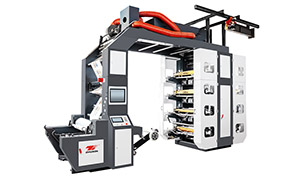
High Speed Flexo Printing Machine - Stack Flexo Flexo Printing Machine
Infrared (IR) dryers emit radiant heat that directly warms the ink film, promoting evaporation from the inside out. They are often used as boosters for water-based inks, especially on heavy coverage areas. IR can be medium-wave or short-wave, with short-wave penetrating deeper. However, IR can overheat thin films, so careful distance control is necessary.
UV curing systems use mercury arc lamps or UV LED arrays to initiate polymerization. Arc lamps produce broad-spectrum UV with high intensity but generate significant heat and have limited life (500-1000 hours). UV LEDs are cool-running, instant-on, and last 20,000+ hours, but require LED-compatible inks. The curing energy is measured in mJ/cm² and must match the ink's photoinitiator absorption spectrum.
EB curing is less common in flexo due to high capital cost and inerting requirements, but it offers near-instant cure without heat, perfect for heat-sensitive substrates and high-speed lines. It uses an electron accelerator to generate a beam that penetrates the ink layer, causing rapid crosslinking. No photoinitiators are needed, reducing potential migration concerns.
Design considerations: The drying system must be integrated with the press speed—higher speeds need more energy or longer dryer tunnels. The distance between the printing nip and dryer should be minimal to prevent ink set-off. Air impingement velocity and temperature profiles are optimized via computational fluid dynamics for uniform drying across the web width. Waste air handling (for solvent-based inks) requires emission control systems such as thermal oxidizers or solvent recovery units.
Troubleshooting: Insufficient drying leads to smearing, set-off, or poor adhesion. Solutions include increasing temperature, slowing press speed, improving air circulation, or adding an IR pre-heater. Over-drying can cause substrate shrinkage, curl, or embrittlement; reduce heat or increase web cooling downstream. Regular maintenance includes cleaning nozzles, replacing filters, checking heater elements, and calibrating temperature sensors. A well-designed flexo drying system ensures consistent print quality, maximizes productivity, and minimizes waste in modern packaging operations.