flexo corrugated printing
Flexo corrugated printing is the standard method for printing graphics on corrugated board used for shipping boxes, retail displays, point-of-purchase materials, and e-commerce packaging. The process uses flexographic presses with thick, resilient plates that can handle the rough, uneven surface of corrugated board, applying water-based inks that dry quickly by absorption and evaporation.
There are two main approaches: post-print and pre-print. Post-print means printing directly on the already-fluted and laminated corrugated board (the finished box blanks). This is done on stack flexo presses with large impression settings to accommodate board thickness. It is economical for short to medium runs and is the most common method for shipping boxes. Pre-print involves printing on the linerboard before it is laminated to the flute, using CI flexo presses for high-quality graphics on the outer liner, then converting the printed roll into board. Pre-print offers superior quality and is used for retail displays and high-end consumer packaging.
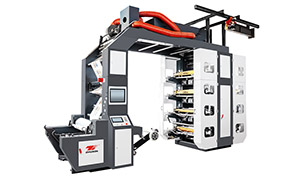
High Speed Flexo Printing Machine - Stack Flexo Flexo Printing Machine
Press types for corrugated: Stack presses (2-6 colors) are the workhorses for post-print, handling board thickness up to 12 mm and widths up to 2800 mm. They are robust with heavy-duty impression cylinders. For pre-print, CI presses with widths up to 2500 mm and speeds over 400 m/min are used, with advanced register control for multi-color line and half-tone work. Some machines combine print and die-cutting inline for one-pass production of box blanks.
Inks for corrugated are predominantly water-based due to low VOC, quick absorption into the paper fibers, and low cost. They are formulated to penetrate the surface without excessive spreading, maintaining dot sharpness. Additives like waxes and slip agents provide rub resistance. Drying is achieved through hot air or IR dryers, but since paper is porous, much of the moisture is absorbed; drying mainly serves to set the resin binder.
Quality considerations: The rough surface of corrugated board limits fine detail and minimum dot size. Typical print resolution is 25-40 lines per centimeter (65-100 lpi) for post-print, while pre-print can achieve 52-60 l/cm (130-150 lpi). Dot gain is significant, so plates are engineered with reduced dot sizes. Impression pressure must be carefully set to avoid crushing the flutes, which weakens the board. Over-impression leads to board damage and print smearing.
Drying and curing: Post-print presses require long dryer tunnels due to heavy ink coverage. Often, a combination of hot air and IR is used to ensure that the board exits dry enough for stacking without ink set-off. Stacking freshly printed boxes requires careful cooling and separation to avoid blocking.
Cost and productivity: Post-print stack presses are relatively low-cost and simple to operate, with quick job changeovers (under 30 minutes). Pre-print CI presses are expensive but offer high quality and consistency for long runs. Many large corrugators operate both: pre-print for retail-ready packaging and post-print for standard shipping boxes. The choice depends on run length, quality requirements, and budget. With growing e-commerce and sustainable packaging, flexo corrugated printing continues to innovate with water-based barriers, high-graphics, and integrated automation.