flexo UV curing
UV curing is a photochemical process used in flexo printing to instantly polymerize and solidify UV-flexo inks upon exposure to ultraviolet light. Unlike thermal drying, UV curing converts liquid inks into solid films within milliseconds, enabling immediate handling, lamination, and stacking without smearing or set-off.
The UV curing system typically consists of a UV lamp (mercury, metal halide, or gallium-doped) housed in a reflector assembly, with a shuttered opening to direct light onto the printed web. The lamp emits a broad spectrum of UVA (320-400 nm), UVB (280-320 nm), and some UVC, which activates photoinitiators in the ink to initiate free-radical polymerization. The energy delivered is measured in mJ/cm² and must match the ink's required dose for complete cure.
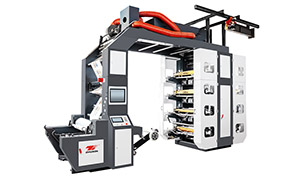
High Speed Flexo Printing Machine - Stack Flexo Flexo Printing Machine
Lamp types: Standard mercury arc lamps are affordable and offer high intensity but generate significant heat and have limited life (500-1000 hours). They require warm-up time and produce ozone. Metal halide lamps have enriched spectra for deeper curing. Gallium-doped lamps are used for specific photoinitiators. Water-cooled or air-cooled systems manage the heat; water-cooled is more efficient but complex.
Curing energy and speed: The required energy dose depends on the ink thickness, pigment loading, and photoinitiator package. Typical doses are 200-800 mJ/cm². Higher speed requires higher lamp power or multiple lamps. Modern systems use UV sensors to monitor lamp output and automatically adjust power or slow the press if the lamp degrades.
Heat management: UV lamps emit significant infrared heat, which can damage heat-sensitive films (shrink sleeves, PE). To mitigate, use IR-reflective filters, cold-mirror reflectors, or move the lamp further from the web. Some systems use chilled rollers behind the web to extract heat. For very sensitive substrates, UV LED curing (see LED topic) is preferred.
Safety: UV radiation is harmful to eyes and skin; the curing unit must have light-tight enclosures and safety interlocks that shut off the lamp if the enclosure is opened. Ozone generated by short-wave UV must be exhausted. Operators wear UV-blocking goggles and gloves when working near the lamp. Waste UV lamps contain mercury and must be disposed of as hazardous waste.
Maintenance: Clean reflectors and lamp quartz envelopes regularly to maintain output; dirt reduces UV transmission. Replace lamps according to manufacturer hours (tracked by hour-meter). Check cooling water or air filters. Calibrate UV intensity sensors with a radiometer. Properly maintained UV curing ensures consistent ink cure, preventing surface tackiness, poor adhesion, and poor scratch resistance. It is essential for high-speed label, film, and shrink sleeve printing where instant cure is mandatory for productivity and quality.