flexo LED curing
UV LED curing is an advanced technology that uses light-emitting diodes to generate narrow-band ultraviolet light (typically at 365 nm or 385 nm) to polymerize specially formulated UV-flexo inks. Unlike traditional mercury arc lamps, LEDs emit a single wavelength, have no warm-up time, produce minimal heat, and last significantly longer, making them a game-changer for flexo printing on heat-sensitive substrates.
The LED curing module consists of an array of chips mounted on a cooling plate (air or water cooled), with a protective window and optics to focus the UV onto the web. The irradiation intensity is controlled by varying the current, allowing instant on/off and power adjustment. LED lamps are available in widths up to 2 meters, and multiple modules can be cascaded for wider webs or higher speeds.
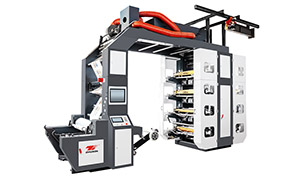
High Speed Flexo Printing Machine - Stack Flexo Flexo Printing Machine
Advantages: 1) Instant on/off – no warm-up, saving energy and reducing downtime. 2) Long lifetime – up to 20,000 hours, reducing lamp replacement frequency. 3) Low heat – minimal IR output, safe for shrink films, PE, PP, and thin papers without cooling rollers. 4) Energy efficient – up to 60% less electricity than mercury lamps. 5) No ozone generation – safer and simpler ventilation. 6) Consistent output – stable intensity over life, improving cure reliability.
Ink compatibility: UV LED requires inks with photoinitiators that match the LED wavelength (e.g., 365 nm for many formulations, 385 nm for deeper penetration). Not all conventional UV inks are LED-curable; converters must switch to LED-specific inks, which are available from major ink manufacturers. These inks often have slightly higher cost but offset with lower energy and maintenance costs.
Curing performance: The narrow wavelength can cause incomplete cure if the ink thickness is high or if pigments absorb the LED light. Multiple passes or higher intensity modules may be needed. For white inks (titanium dioxide), which are highly reflective, specific LED formulations with high initiator levels are required. The depth of cure is generally less than with broad-spectrum lamps, so film thickness must be controlled.
Integration: LED modules are smaller and lighter than mercury lamp housings, allowing easier installation in tight spaces of narrow-web and mid-web presses. They can be placed closer to the web due to low heat, reducing the distance and increasing efficiency. Some presses integrate LED curing in each color station for perfect interstation cure, enabling wet-on-wet printing for some applications.
Maintenance: LED systems require minimal maintenance – clean the window with a soft cloth (avoid scratches), check cooling fluid levels or clean air filters, and monitor chip temperature. The output degrades slowly; a radiometer should be used periodically to verify intensity. If intensity drops below 80%, the module may need replacement or repair. The lifetime cost is lower than mercury lamps, and the environmental benefits (no mercury disposal, lower CO2 footprint) align with sustainability goals.
Application scope: LED curing is dominant in narrow-web label printing and growing in film, shrink sleeve, and even corrugated pre-print. For food packaging, low-migration LED inks are available. It is also ideal for printing on temperature-sensitive materials like OPS, PVC, and LDPE. As LED technology advances, it is replacing mercury lamps in many new press installations, offering higher uptime, better cure consistency, and a greener footprint.