doctor blade
This content introduces working modes, mainstream types, installation specifications and failure troubleshooting of flexo doctor blades, explaining its key function in scraping excess ink and ensuring uniform ink transfer in flexo printing production.
The doctor blade is a precise auxiliary component matched with anilox roller in flexo printing units, undertaking the core task of scraping excess surface ink on anilox roller before ink transfer to printing plates. After the anilox roller is dipped into the ink tank and carries ink out of the liquid level, a layer of floating ink will cover the roller surface outside engraved cells. The doctor blade fits closely with the roller surface to scrape all redundant floating ink off, only retaining quantitative ink stored in concave cells for subsequent pattern printing.
Reasonable contact pressure between doctor blade and anilox roller is the key to stable ink metering effect. Excessive contact pressure will cause severe wear on both blade edge and ceramic roller surface, increasing equipment loss cost and changing original cell volume of anilox roller. Too small pressure cannot completely scrape surface floating ink, resulting in excessive ink output, blurred pattern edges and printing ink overflow defects.
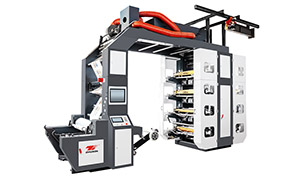
High Speed Flexo Printing Machine - Stack Flexo Flexo Printing Machine
Flexo printing industry mainly adopts two mainstream doctor blade structures: chambered doctor blade system and single reverse doctor blade system. The reverse single doctor blade has simple structure, low cost and convenient replacement, which is commonly used in old low-speed flexo presses. The integrated chambered doctor blade system realizes closed-loop ink supply and scraping, which can effectively reduce ink solvent volatilization, stabilize ink viscosity and adapt to high-speed and high-precision modern flexo printing production lines.
Blade material selection directly affects scraping effect and service life. Common doctor blade materials include carbon steel, stainless steel and composite polymer materials. Carbon steel blades have low hardness and good fitting performance, suitable for medium and low-speed printing scenarios. Stainless steel blades feature strong wear resistance and long service life, matching high-speed wide web flexo presses. Polymer blades will not scratch high-precision ceramic anilox rollers, which are preferred for ultra-fine pattern printing with strict surface protection requirements.
Common daily faults of doctor blades include blade edge wear, uneven fitting gap and blade bending deformation. Uneven fitting gap will lead to strip-shaped light and dark color difference on printed substrates. Timely regular replacement of vulnerable blades and calibration of blade parallelism with anilox roller are routine maintenance work for flexo printing workshops. Standardizing blade installation angle and pressure parameters can maximize ink metering accuracy and reduce the rate of finished product defects caused by ink thickness difference.