anilox roller
This page focuses on the working principle, classification parameters, selection criteria and daily maintenance methods of anilox rollers, revealing how this core component controls ink dosage and determines the color density of flexo printed products.
The anilox roller is the core metering and ink transfer component exclusive to flexographic printing systems, responsible for quantitatively transferring fixed volume of flexo ink to the surface of flexo printing plates. Different from ink transfer rollers in offset printing and gravure printing, the surface of anilox roller is engraved with countless uniform tiny concave cells, which can store precise ink volume during roller rotation and realize quantitative ink supply without manual ink thickness adjustment in the whole printing process.
Cell structure parameters are the most critical indicators to distinguish different anilox rollers, mainly including cell line number and cell volume. Cell line number refers to the number of concave cells per inch on the roller surface; higher line number means finer cells, suitable for printing fine lines, texts and gradient patterns. Cell volume represents the maximum ink storage capacity of single cell, directly determining the ink thickness transferred to printing plates and the final color saturation of printed patterns.
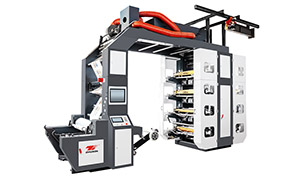
High Speed Flexo Printing Machine - Stack Flexo Flexo Printing Machine
According to manufacturing processes, anilox rollers are mainly divided into three categories: mechanical engraved rollers, ceramic coated laser engraved rollers and chrome-plated rollers. Mechanical engraved anilox rollers have low cost but uneven cell structure, which are only suitable for rough color block printing with low precision requirements. Ceramic laser engraved anilox rollers have uniform and wear-resistant cells, becoming mainstream configurations for high-precision modern flexo presses. Chrome-plated anilox rollers have moderate cost and are widely used in medium-precision packaging printing production.
The matching selection of anilox rollers needs to combine printing pattern type, ink type and substrate material. For large solid color block printing, operators should choose low line number and large cell volume anilox rollers to meet high ink demand. For fine text and halftone dot printing, high line number anilox rollers are required to reduce ink transfer volume and avoid dot expansion. Water-based flexo ink and solvent-based ink also need matched cell parameters to adapt to different ink viscosity characteristics.
Long-term scientific maintenance can effectively extend the service life of anilox rollers and stabilize ink transfer performance. Residual dried ink inside concave cells is the main cause of printing defects such as insufficient ink color and uneven pattern. Regular ultrasonic cleaning and chemical cleaning are required to remove residual ink thoroughly. Meanwhile, hard collision and scratch on the roller surface should be avoided during disassembly and installation, because tiny scratches on cell surface will lead to local abnormal ink transfer and affect overall printing quality.