Wide Web Flexo Process Stability: Managing Web Distortion and Registration at High Speeds
Operating a wide web flexo press at speeds of 400-500 m/min introduces significant process stability challenges, primarily due to the large web mass and the long web path. Any slight disturbance – tension fluctuation, thermal change, or mechanical vibration – can amplify into visible registration errors or web breaks. This article explores the engineering strategies to maintain stable printing in high-speed wide web applications.
The primary source of instability is web distortion due to tension and temperature. As the web passes through the printing and drying sections, it may stretch (elastic deformation) or shrink (thermal or moisture loss). In a wide web, the distortion can be non-uniform across the width if the tension or drying is uneven. For example, if the center of the web is hotter than the edges, the center will shrink more, causing a "baggy" web that is difficult to register. To counter, wide web presses employ multiple temperature sensors across the width and use zoning in drying tunnels to maintain a uniform temperature profile. Additionally, the tension profile is often set to be slightly higher at the edges (using edge-tension control) to keep the web flat.
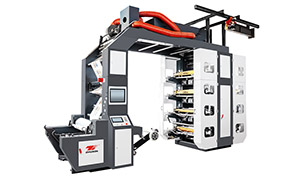
High Speed Flexo Printing Machine - Stack Flexo Flexo Printing Machine
Dynamic register control: The register control system must compensate for the web's elastic behavior. In wide web presses, the web acts as a long spring; any change in tension changes the web length between color decks. The controller uses a feedforward model that predicts the tension-induced stretch based on the web's elastic modulus, which is known from the substrate database. When the press accelerates, the controller adjusts the phase of each deck's servo motor proactively, reducing the need for reactive corrections. This "predictive register" can maintain accuracy within ±0.05 mm even during speed changes.
Damping of web vibration: The long spans between rollers in a wide web press can lead to web fluttering or standing waves. To suppress this, some presses incorporate active damping devices: a small roller that moves up and down at a controlled frequency to cancel out the vibration. Alternatively, air bars with controlled pressure can provide a stabilizing air cushion. These damping systems are tuned to the natural frequency of the web span, which is calculated from the web tension and mass per unit area.
Thermal management for large cylinders: The impression cylinder and central drum (if CI) are subject to frictional heating and heat absorption from dryers. Their thermal expansion must be managed to maintain a constant repeat length. Wide web drums often have internal cooling channels with a high flow rate of temperature-controlled water. The cooling system's capacity is designed to remove heat at the maximum production speed, maintaining the drum temperature within ±1°C. Sensors on the drum surface feed back to the chiller; if the temperature rises, the chiller increases flow or lowers the inlet temperature.
Web guidance and tracking: At high speeds, any lateral force (e.g., from a slightly misaligned roller) can cause the web to walk. Wide web presses have multiple edge guides at strategic points, and the feedback loop is fast (response <100 ms) to correct lateral wander before it affects register. Some presses use a "steering roller" with a high-speed actuator that can shift the web at rates up to 20 mm/s.
Quality monitoring: Inline inspection cameras with high-speed line scan sensors (up to 100 kHz) capture the entire width at full speed. Defects like streaks, hickeys, and register errors are detected in real-time. The system can mark defective areas for later removal or, in advanced setups, automatically adjust press parameters to correct the issue (e.g., increase impression if density drops). The data is logged for root-cause analysis.
Operational best practices: Warm-up procedures are extended for wide web presses – often 60 minutes at slow speed with dryers on to reach thermal equilibrium. Substrate splicing must be done with high-quality tape and a clean cut to avoid web breaks. The press operator monitors tension trends on a graphical display and can intervene if any zone shows deviation. By combining robust mechanical design, sophisticated control algorithms, and vigilant monitoring,
wide web flexo presses achieve remarkable stability, delivering high-quality output over long runs with minimal downtime, essential for cost-effective mass production of packaging materials.