Wide Web Flexo Press Mechanical Design for High-Tension, Heavy Substrates
Wide web flexo presses, typically defined as those with a maximum printing width of 1600 mm to 2800 mm, are designed for high-volume production of flexible packaging, corrugated pre-print liner, and heavy-duty industrial materials. The scale of these presses introduces unique mechanical challenges: web tensions can exceed 1000 N total, roller weights are measured in tons, and the sheer width amplifies any misalignment or deflection. This article examines the engineering principles behind wide web flexo machines.
The most critical aspect is frame rigidity. The press frame must resist bending and twisting under the combined loads of web tension, cylinder weights, and dynamic forces. Wide web frames are constructed from heavy-gauge steel box sections, often filled with polymer concrete for damping. The side frames are tied together with cross-beams at multiple levels to create a monocoque structure. Finite element analysis is used to optimize the frame geometry, ensuring that deflection under maximum load is below 0.02 mm per meter of width. This stiffness is essential to maintain uniform nip pressure across the entire web, preventing "edge-to-center" density variations.
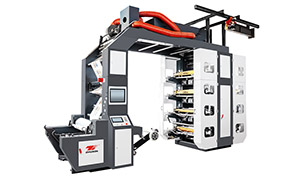
High Speed Flexo Printing Machine - Stack Flexo Flexo Printing Machine
Roller design for wide webs: All rollers, especially the impression cylinder and the central drum (in CI presses), must have a crowned profile to compensate for the deflection caused by the web tension and roller weight. The crown is typically 0.2-0.5 mm over the roller length, precisely calculated based on the roller's material, diameter, and load. The rollers are dynamically balanced to G0.4 grade to avoid vibration. Bearings are oversized (often spherical roller bearings) with high load capacity and automatic lubrication systems. The anilox rollers in wide web presses are massive ceramic-coated cylinders, weighing up to 500 kg, requiring robust bearing housings and specialized handling tools for cleaning and replacement.
Tension control in wide webs: The tension setpoints are higher – for board, up to 4 N/cm width, translating to over 1000 N total. The unwind and rewind motors must be high-torque with regenerative braking. Tension control zones are isolated by multiple dancers with large pneumatic cylinders. The control system uses a cascade architecture: a master speed reference, with individual tension PID loops for each zone. Because of the high inertia of the web, the acceleration and deceleration ramps must be carefully programmed to avoid tension overshoot, which could snap the web or cause register errors.
Web guiding: Wide webs require powerful edge guide systems with long steering roller assemblies. The actuators are often hydraulic or large servo motors that can shift a heavy roller frame. The sensor must have a wide detection range (e.g., 50 mm) to accommodate web wander. Some presses use a "center guide" system that keeps the web centered regardless of width variations, which is crucial when printing on rolls with different widths.
Drying systems for wide webs: The drying tunnels are large, with multiple heating zones across the width. Uniform air distribution is achieved by using multiple fans and baffles; uneven drying can cause cockling or fluting in paper/board. The exhaust air volume is substantial, requiring efficient heat recovery to reduce energy costs. For UV curing, multiple lamp modules are arrayed across the width, and their power must be synchronized to avoid curing gradients.
Maintenance and access: Wide web presses are often installed in pits or with elevated walkways to allow access to the upper decks. The large components require overhead cranes for maintenance. Scheduled maintenance includes regular checking of frame alignment using laser measurement, inspection of all bearings and gears, and calibration of tension sensors. The scale of wide web flexo justifies the investment in condition monitoring systems, such as vibration analysis and thermal imaging, to prevent catastrophic failures.
Despite the challenges, wide web flexo presses are indispensable for industries like corrugated pre-print (where linerboard up to 2.8 m wide is printed before fluting) and heavy-duty flexible packaging (e.g., agricultural films, construction membranes). The combination of robust mechanical design, advanced control, and careful maintenance ensures that these presses achieve consistent quality and high uptime, producing millions of square meters of printed material annually.