Wear Failure Mechanism of Anilox Roller and On-site Performance Recovery Technology
This technical paper analyzes three typical wear failure forms of ceramic anilox rollers in mass production, explores cell volume attenuation rules during service life, and introduces non-destructive on-site roller recovery technology to reduce replacement cost.
Long-term operation of anilox rollers inevitably causes micro wear on cell edges under continuous friction with doctor blades. Edge wear changes original regular cell geometry, reduces effective cell volume gradually, and leads to continuous color fading in printed products. Most printing factories ignore gradual wear attenuation and only replace rollers after obvious color defects, resulting in large batches of defective products.
Three typical wear failure modes of anilox rollers are edge passivation, cell wall scratch and cell bottom polishing. Edge passivation is the most common failure, which reduces ink release rate without damaging cell structure completely. Cell wall scratches cause local ink leakage and vertical printing stripes. Cell bottom polishing eliminates micro concave structure and makes cells lose ink storage capacity permanently.
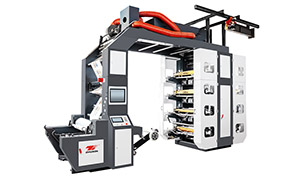
High Speed Flexo Printing Machine - Stack Flexo Flexo Printing Machine
Quantitative attenuation rule of
anilox roller cell volume follows linear wear curve. For conventional carbon steel doctor blade matching, the effective cell volume decreases by 0.8% per 100,000 meters of printing length. After printing 800,000 meters, the cell volume attenuation exceeds 6%, which reaches the critical failure threshold requiring roller maintenance or replacement.
Different doctor blade materials bring differentiated wear degrees to ceramic anilox rollers. Polymer composite blades produce the minimum wear, reducing cell attenuation rate by 70% compared with carbon steel blades. Stainless steel blades have moderate wear speed with balanced cost and service life. It is forbidden to match ultra-hard alloy blades with ceramic rollers to avoid irreversible cell damage.
Non-destructive laser surface repair technology realizes on-site recovery of slightly worn anilox rollers. The precise laser repair system re-engraves worn cell edges without changing original cell line count and overall structure, recovering more than 95% of original ink transfer capacity. This technology saves 60% cost compared with purchasing brand-new anilox rollers for slight wear failure.
Anilox roller life prediction model based on printing mileage and blade matching helps enterprises formulate scientific replacement plans. Combined with real-time printing mileage data, blade type and daily cleaning frequency, the model predicts remaining service life of each roller accurately. Planned roller replacement avoids sudden production halt caused by unexpected roller failure and reduces defective product loss effectively.