Water-Based Flexo Ink Formulation Chemistry and Pigment Dispersion Stability for Consistent Color
The performance of water-based flexo inks is determined by their formulation, which includes pigments, resins, water, and additives. Achieving consistent color and print quality requires a deep understanding of the chemistry behind pigment dispersion, resin binding, and the stabilization of the colloidal system. This article explores the key formulation principles and their impact on printing.
Pigments are insoluble particles that provide color. They are dispersed in water using dispersing agents (surfactants or polymeric dispersants) that adsorb onto the pigment surface and create electrostatic or steric repulsion to prevent agglomeration. The dispersion quality affects color strength, transparency, and rheology. Poor dispersion leads to flocculation, which causes color shifts, low gloss, and nozzle clogging (if used in inkjet). The pigment particle size (typically 100-500 nm) must be controlled by milling processes; smaller particles improve color strength but increase viscosity.
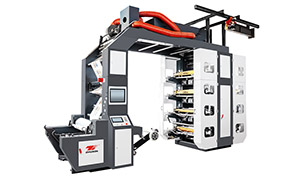
High Speed Flexo Printing Machine - Stack Flexo Flexo Printing Machine
Resin binders are the film-forming components. Common types include acrylic-styrene copolymers, polyurethane dispersions, and rosin esters. The resin provides adhesion to the substrate, mechanical resistance (scratch, block), and determines the ink's water resistance after drying. The resin's glass transition temperature (Tg) affects film hardness: higher Tg (e.g., 60°C) gives hard, abrasion-resistant films but requires higher drying temperature; lower Tg (e.g., 20°C) gives flexible films but may be tacky. The resin also influences the ink's viscosity and pigment wetting.
Additives play crucial roles: defoamers (silicone or mineral oil) prevent foam during pumping and printing; wetting agents (surfactants) reduce surface tension to improve substrate wetting; slip agents (waxes) provide rub resistance; preservatives (biocides) prevent bacterial growth in the water-based system. The pH of the ink is typically 8.0-9.5, maintained by amine compounds, which also help dissolve the resin. pH drift can cause viscosity changes and resin precipitation, so pH buffers are often included.
Stability during printing: The ink circulates through pumps, pipes, and anilox chambers, where shear forces and temperature changes can destabilize the dispersion. Mechanical shear can break pigment agglomerates but can also cause flocculation if the dispersant is sheared off. Temperature increase lowers viscosity but can accelerate evaporation, increasing solids content and viscosity – a phenomenon called "water loss." To maintain stability, the ink system includes a viscosity control loop that adds water or solvent adjusters as needed. Closed-loop viscosity control using a viscometer is standard in modern presses.
Color consistency: The final color depends on the pigment load, dispersion quality, and the film thickness. Variations in anilox volume or impression pressure change the film thickness, shifting color. To compensate, some inks are formulated with a "wide latitude" – they can tolerate ±20% thickness variation without significant color shift. The ink's color strength is measured by a spectrophotometer, and adjustments are made by adding concentrated pigment paste. The ink manufacturer provides a color formula that specifies the exact amounts of each component.
Environmental and health aspects: Water-based inks are low in VOCs, but they still contain small amounts of co-solvents (e.g., glycols) to improve flow and freeze-thaw stability. The solvents are typically safe and biodegradable. Waste ink must be treated as industrial wastewater, requiring neutralization and flocculation before disposal.
By fine-tuning the formulation and controlling the process parameters,
water-based flexo inks deliver excellent print quality with low environmental impact, making them the preferred choice for sustainable packaging. Continuous research focuses on bio-based resins, higher solids content, and improved pigment dispersion to further enhance performance and reduce energy consumption.