Water-Based Flexo Ink Drying Kinetics and Evaporation Modeling for High-Speed Printing
The drying of water-based flexo inks is a complex coupled heat and mass transfer process where water evaporates from the ink film, leaving a solid resin binder on the substrate. At high press speeds (400-600 m/min), the residence time in the dryer is only 0.5-2 seconds, requiring extremely efficient evaporation. This article develops a mathematical model of the drying process and discusses strategies to maximize drying rate without damaging the substrate.
The evaporation rate is governed by the convective mass transfer equation: ṁ = k_m × (p_vs - p_v∞) / (R × T), where k_m is the mass transfer coefficient, p_vs is the vapor pressure at the ink surface, p_v∞ is the partial pressure in the bulk air, and T is temperature. The mass transfer coefficient depends on air velocity and nozzle geometry; for impinging jets, k_m ∝ Re^0.5 × Pr^0.33. The vapor pressure at the ink surface is lowered by the presence of resin and pigments (Raoult's law effect) and by the ink's water activity, which decreases as water content drops, causing a falling rate period.
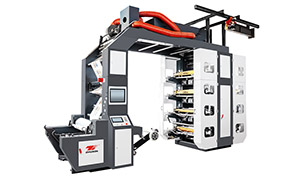
High Speed Flexo Printing Machine - Stack Flexo Flexo Printing Machine
The drying curve typically shows a constant rate period (when the ink surface is saturated) followed by a falling rate period (when water diffusion within the film becomes limiting). For water-based flexo inks, the constant rate period is short (0.1-0.3 s) because the ink film is thin (5-20 µm). To maximize drying, the dryer must provide high turbulence and temperature to maintain a high p_vs, but the substrate temperature must stay below its softening point (e.g., 80°C for PE, 120°C for paper). The heat transfer coefficient (h) from the air to the web is related to k_m via the Chilton-Colburn analogy: h = ρ × c_p × Le^(2/3) × k_m, where Le is the Lewis number (≈1 for air-water). This relationship allows estimation of drying rate from measured heat transfer.
Optimization strategies: Increasing air velocity from 10 to 30 m/s doubles the mass transfer coefficient. Raising air temperature from 60 to 100°C increases the vapor pressure difference by a factor of 3, but also raises substrate temperature. A two-zone dryer is often used: a first zone at moderate temperature with high velocity to evaporate most water without overheating, and a second zone at higher temperature to remove residual moisture and crosslink the resin. Additionally, using air with low humidity (dew point <10°C) increases the driving force, especially in humid climates; this is achieved by using desiccant dehumidifiers.
Substrate effects: Porous substrates like paper absorb water, reducing the evaporation demand but also affecting the ink film's integrity. The absorbed water can cause swelling and cockling, which must be controlled by balancing the drying rate with the absorption rate. For non-porous films, all water must be evaporated; therefore, the drying load is higher, and the ink must have higher solids content to reduce water amount.
Model validation: Experimental drying curves are obtained using a lab-scale dryer with controlled temperature, velocity, and humidity. The parameters (k_m, h) are fitted, and the model is used to predict drying for different press speeds. The model can be integrated into the press control system to set the dryer power based on real-time speed and ink coverage, minimizing energy waste.
Future directions: Hybrid drying with IR pre-heating can increase the constant rate period by raising the ink temperature, but must be carefully controlled to avoid film defects. Also, the use of high-solid inks (60-70% solids) reduces the water load, enabling higher speeds. By understanding the kinetics, converters can optimize their drying systems for maximum productivity and quality, reducing energy costs and environmental footprint.