Used Flexo Press for Sale: Economic Evaluation and Refurbishment vs. New Decision
Buying used can save 30-60% over new, but the lower price must be weighed against higher maintenance, lower efficiency, and lack of modern features. This article provides a framework for economic evaluation and refurbishment decisions.
First, estimate the cost of refurbishment. This includes: replacing worn anilox rollers ($5k-20k each), replacing bearings and seals ($2k-10k per deck), overhauling the control system (if obsolete, $50k-100k), upgrading drying/curing (e.g., adding LED, $100k-200k), and general cleaning and repainting. The total refurbishment cost can be 20-40% of the purchase price. A thorough inspection (as above) is needed to estimate this.
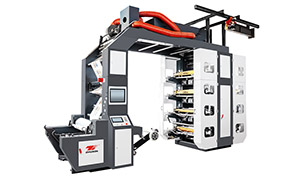
High Speed Flexo Printing Machine - Stack Flexo Flexo Printing Machine
ROI comparison: Compare the total cost of a used+refurbished press vs. a new press with similar specifications. Include the expected higher maintenance cost of the used press (typically 1.5-2x of new) and its lower energy efficiency (older dryers are less efficient). Also, the used press may have lower maximum speed or automation, reducing productivity. Calculate the payback period for the new vs. used option. If the used option has a payback of <2 years, it may be attractive; if >3 years, new may be better.
Upgrade options: Many older presses can be retrofitted with modern automation (servo drives, register control, cameras) and LED curing. This can bridge the performance gap. However, the cost of retrofitting can be high and may not achieve the same integration as a new press. Check with the original manufacturer or third-party specialists for upgrade kits. Some presses are modular and easier to upgrade.
Risk factors: Used presses have unknown history; hidden wear may cause early failure. The warranty is typically limited (30-90 days) compared to 1-2 years for new. The press may not be able to handle new substrates (e.g., thinner films) without modifications. The resale value of a used press after a few years is lower than a new one.
Financing: Used equipment financing may have higher interest rates and shorter terms. Leasing a used press may be difficult. Factor in the cost of financing.
Decision matrix: Create a scorecard with criteria: cost, productivity, quality, energy, maintenance, flexibility, and risk. Assign weights based on business priorities. Compare the total weighted score for new vs. used. For converters with tight capital and moderate quality requirements, used can be a good choice. For those requiring high efficiency and low maintenance, new is better.
Case example: A converter considered a used 6-color CI press for $800k, with estimated refurbishment of $200k, total $1M. New equivalent cost $2.5M. The used press had 20% lower speed and 30% higher energy consumption. The payback for used was 1.8 years vs. 2.5 years for new. Given the lower risk (new with warranty), they chose new. However, another converter with limited budget and longer runs chose used and refurbished, achieving acceptable ROI. The decision is case-specific. By performing a rigorous economic evaluation, buyers can make a sound decision between used and new flexo presses.