UV Flexo Ink Rheology and Flow Behavior for Anilox Transfer and Dot Reproduction
The rheological properties of
UV flexo inks – their viscosity, shear-thinning behavior, and thixotropy – play a critical role in the printing process, from anilox cell filling to dot reproduction on the substrate. Unlike water-based inks, UV inks are 100% solids and have higher viscosity (typically 50-500 cps at 25°C). This article examines how rheology affects print quality and how to tailor it for optimal performance.
Ink viscosity is measured with a rotational viscometer (e.g., Brookfield) at a shear rate relevant to the printing process – typically 100-500 s⁻¹ for anilox cell filling. The ink must be fluid enough to fill the anilox cells completely during the short contact time (milliseconds) but thick enough to prevent dripping or misting. UV inks are pseudoplastic (shear-thinning) due to the presence of polymeric oligomers that align under shear. This behavior is beneficial: at high shear rates (e.g., in the anilox nip), viscosity drops, facilitating cell filling; after transfer, at low shear, viscosity increases, helping to maintain dot shape.
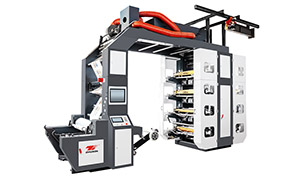
High Speed Flexo Printing Machine - Stack Flexo Flexo Printing Machine
Thixotropy (time-dependent viscosity recovery) is also important. If the ink recovers too quickly after the nip, it may not level on the plate, leading to orange peel. If it recovers too slowly, the ink may flow on the substrate, causing dot gain. The thixotropic recovery time is controlled by the molecular weight of oligomers and the presence of fumed silica or other thickeners. The ideal ink has a recovery time of 0.5-2 seconds, sufficient for transfer and dot formation but not for excessive spreading.
Anilox transfer efficiency depends on the viscosity at the shear rate experienced in the nip. The ratio of the ink film thickness on the anilox to the cell depth is influenced by the capillary number, which is proportional to viscosity × velocity / surface tension. For high-speed printing, lower viscosity improves transfer, but too low viscosity causes misting (droplets flying off the anilox). The optimum viscosity range is typically 80-200 cps at 25°C for conventional UV inks, though high-speed presses may use lower viscosity (50-100 cps) with anti-misting additives.
Temperature effect: UV inks are sensitive to temperature; viscosity typically decreases by 2-5% per °C. Thus, temperature control of the ink supply (via a heat exchanger) is essential to maintain constant viscosity. Many presses use a chiller to keep the ink at a set temperature (e.g., 25°C). The press's viscosity controller can also adjust the feed rate or add a diluent if the viscosity drifts.
Dot reproduction and dot gain: Higher viscosity inks tend to produce sharper dots with less gain because they resist spreading on the substrate. However, they may not fill the anilox cells completely, causing low density. The dot gain is also influenced by the ink's surface tension and the substrate's surface energy. A balanced formulation with moderate viscosity and good wetting properties yields the best compromise. The ink's rheology also affects the degree of dot "shaping" – the dot should be round and uniform.
Practical testing: Printers often run a "rheology sweep" – printing the same job with inks of different viscosities to observe the impact on density, dot gain, and mottle. The results are used to select the optimal viscosity for each substrate and press speed. The ink manufacturer can adjust the rheology by adding reactive diluents (monomers) that reduce viscosity but also affect cure speed and mechanical properties.
Troubleshooting: If the print shows mottling (uneven density), it may be due to thixotropy that is too slow – the ink levels unevenly. Increase thixotropy by adding a rheology modifier. If the print shows "dot bridging," viscosity is too low – increase it or reduce the anilox volume. If there is misting, viscosity is too low; increase it or adjust the doctor blade angle. By mastering rheology, converters can achieve consistent, high-quality UV flexo printing with minimal defects.