UV Flexo Ink Curing Kinetics and Photoinitiator Efficiency for High-Speed LED Curing
UV flexo inks cure via free-radical photopolymerization, a chain reaction initiated by the absorption of UV light by photoinitiators (PIs). The curing kinetics determine the required UV dose, the press speed, and the final properties of the cured film. With the shift to LED curing (narrow-band UV), the photoinitiator system must be specifically matched to the LED wavelength (365 nm or 385 nm). This article analyzes the kinetics and provides guidelines for optimizing LED curing.
The polymerization rate (R_p) is proportional to the square root of the initiator concentration and the incident light intensity: R_p ∝ (I_0 × [PI])^0.5, where I_0 is the irradiance (mW/cm²). The conversion degree (α) as a function of time follows a first-order-like curve with an auto-acceleration period due to the Trommsdorff effect (increased viscosity increases termination rate). The maximum conversion is often limited by the mobility of reactive groups; for UV flexo inks, typical conversion reaches 80-95%. The dose required to achieve >90% conversion is typically 200-500 mJ/cm² for thin films (5-15 µm).
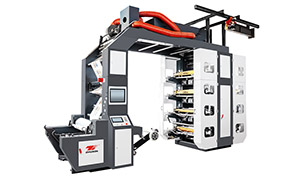
High Speed Flexo Printing Machine - Stack Flexo Flexo Printing Machine
Photoinitiator selection: For LED 365 nm, acylphosphine oxides (e.g., TPO, BAPO) are commonly used because they absorb strongly at this wavelength. For 385 nm, more specialized PIs are needed. The PI must have high quantum yield (>0.5) and generate reactive radicals that initiate polymerization efficiently. The PI concentration is typically 3-6% of the ink weight; higher concentration increases curing speed but can cause migration and yellowing. The absorption spectrum of the PI must overlap with the LED emission; a poor overlap means wasted light.
Curing depth and pigment interference: Pigments absorb UV light, reducing the intensity that reaches the bottom of the film. This is described by the Beer-Lambert law: I(z) = I_0 × exp(-ε × c × z), where ε is the extinction coefficient, c is pigment concentration, z is depth. For highly pigmented inks (e.g., white with TiO₂), curing is limited to the top layer, leaving a liquid underlayer – a defect called "undercure." To mitigate, use high-intensity LEDs (up to 20 W/cm²), multiple lamps, or a dual-wavelength system (e.g., 365 + 385 nm) to improve penetration. Alternatively, use a "gradient" PI system where different PIs are activated at different depths.
Oxygen inhibition: Atmospheric oxygen scavenges radicals, retarding surface cure. This causes tacky surfaces. To counter, inks contain amine synergists that react with oxygen, or the curing is done in an inert atmosphere (nitrogen blanket). For LED systems, which emit no heat and thus allow closer lamp-to-web distance, oxygen inhibition is less problematic because the high intensity quickly overcomes the inhibition period. Nevertheless, high-PI concentrations and high irradiance are recommended.
Thermal effects: UV curing generates heat due to exothermic polymerization and IR radiation from lamps. LED produces minimal IR, so the substrate temperature rise is only 5-10°C, making it ideal for heat-sensitive films. However, the polymerization itself is exothermic (enthalpy ~60 kJ/mol), which can raise the film temperature by 10-20°C, but this is usually beneficial for accelerating cure.
Quality control: Degree of cure is measured by FTIR (monitoring the disappearance of acrylate C=C peak) or by a simple solvent rub test. For consistent cure, the press's UV power and speed are maintained in a closed loop: a UV sensor measures the lamp output, and the press adjusts speed if the output drops (lamp aging). The recommended practice is to run at a speed that gives a 20% margin above the minimum dose, to account for lamp degradation.
By optimizing the photoinitiator system, LED irradiance, and ink film thickness,
UV flexo inks achieve fast, complete cure with excellent adhesion, scratch resistance, and gloss, enabling the highest quality on non-porous substrates with minimal energy and heat.