Technical Process and Quality Difference Between Flexo Printing and Offset Lithography
This in-depth technical article compares core working principles,ink transfer paths,dot reproduction performance and inherent quality defects of flexo relief printing and offset planographic printing,clarifying applicable scenarios for mid-to-high-end packaging commercial printing.
Flexographic printing belongs to direct relief printing technology while offset lithography is indirect planographic printing relying on water-ink repulsion principle.Flexo adopts raised photopolymer plates to transfer low-viscosity ink directly to substrates without intermediate medium,while offset uses flat aluminum plates to transfer ink to rubber blankets first then to printing materials.The essential process difference determines their performance gap in production speed,substrate adaptability and fine pattern restoration.
The ink transfer mechanism gap is the root cause of their quality difference.Flexo uses fixed-volume anilox roller ink metering,with ink layer thickness ranging from 1.8μm to 3.5μm,and ink layer thickness cannot be dynamically adjusted in real time during operation.Offset printing realizes continuous ink volume adjustment via ink roller gap control,forming ultra-thin uniform ink layers within 0.8μm to 1.5μm,which supports smoother color gradient transition and finer highlight dot performance.
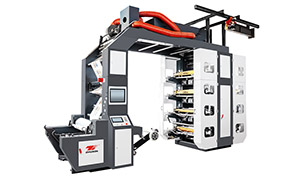
High Speed Flexo Printing Machine - Stack Flexo Flexo Printing Machine
Dot gain rules differ greatly between flexo and offset under actual production pressure.Flexo has unavoidable dot gain ranging from 12% to 22% due to elastic plate compression deformation,especially obvious for 2%-10% highlight halftone dots.Offset printing has rigid metal plates and indirect pressure transfer,with controlled dot gain below 6%,achieving excellent restoration of tiny text and ultra-fine gradient patterns without pattern edge distortion.
Substrate adaptability shows absolute advantages of flexo printing.Flexo can stably print on porous paper,non-absorbent plastic films,corrugated board and nonwoven fabrics thanks to flexible plate fitting performance.Offset printing only adapts to flat smooth paper substrates,and cannot complete high-quality printing on rough,elastic or curved materials due to rigid blanket transfer structure.
Production efficiency and prepress setup cost contrast in mass production scenarios.Flexo web-fed presses support continuous high-speed production up to 600m/min with long-run low unit cost,but require longer prepress plate mounting and parameter debugging time.Offset sheet-fed presses have lower running speed,fast short-run startup debugging,but higher unit production cost for large batch orders exceeding 50000 pieces.
Environmental protection and post-press compatibility differences cannot be ignored.Modern flexo widely uses water-based and UV zero-VOC inks matching online die-cutting and laminating functions for one-stop packaging production.Offset mostly uses solvent-based inks with higher VOC emissions,and needs independent offline post-press processing,cannot integrate inline finishing units efficiently.