Technical Limitation Mechanism of Maximum Flexo Printing Speed and Stability Boundary Calibration
This deep technical article reveals core physical limitations restricting flexo printing maximum speed, analyzes the response delay of servo system and drying bottleneck under ultra-high speed operation, and provides stability boundary calibration parameters for different web materials.
The maximum mechanical speed of a flexo press does not equal the stable production speed, and the stability speed boundary is restricted by three core technical bottlenecks: servo motor synchronous response speed, ink drying heat transfer efficiency, and web tension real-time adjustment response time. Most manufacturers mark mechanical speed up to 600m/min for wide web presses, while the actual stable defect-free production speed is limited to 380m/min to 450m/min due to inherent technical limitations.
Servo synchronous response delay is the primary mechanical factor limiting high-speed flexo printing. Each printing unit needs to keep phase synchronization within 0.01ms to ensure precise registration. When the running speed exceeds 450m/min, the servo drive system produces subtle phase delay between adjacent color units, resulting in cumulative transverse and longitudinal registration errors that visual correction systems cannot fully compensate.
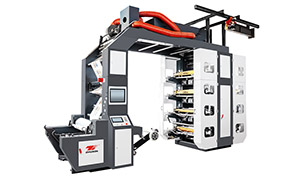
High Speed Flexo Printing Machine - Stack Flexo Flexo Printing Machine
Ink drying heat transfer bottleneck is the biggest process limitation for high-speed flexo printing. As printing speed rises, the residence time of substrates in the drying tunnel decreases linearly. For water-based flexo ink, the effective drying time reduces to less than 0.3s when speed exceeds 400m/min, which is far below the minimum 0.8s required for complete water evaporation. Insufficient drying leads to ink back-sticking, pattern blurring and winding adhesion defects in continuous production.
Web tension dynamic response lag restricts high-speed speed stability for thin film substrates. Thin plastic films have low structural rigidity, and rapid speed acceleration or deceleration will cause tension oscillation. Even with closed-loop tension control system, the tension adjustment response lag reaches 20ms under ultra-high speed, bringing periodic web jitter and affecting pattern uniformity.
Speed grading calibration standards for different mainstream substrates are summarized based on massive production data. Nonwoven fabrics support the lowest stable speed at 220m/min due to loose fiber structure and easy deformation. Paper and paperboard support stable speed up to 350m/min. BOPP and PET film with high structural rigidity can reach stable speed of 420m/min. UV ink matched presses can increase stable speed by 15% compared with water-based ink presses thanks to instant curing performance.
Three technical upgrading schemes to break
flexo printing speed limitations: upgrading high-response servo motors to shorten synchronous delay, adopting multi-stage cascade drying tunnels to prolong effective drying time indirectly, and installing active tension damping rollers to eliminate high-speed tension oscillation. These combined upgrades can lift the stable production speed boundary by 20% while maintaining original printing quality.