Stack Flexo Press Multi-Color Drying Management and Inter-deck Web Conditioning
In a stack flexo press, each color is applied sequentially as the web travels vertically upward or downward through the decks. Between decks, the printed ink must be sufficiently dried or cured to prevent offsetting when the web contacts the next deck's impression cylinder. However, the drying process affects the substrate's moisture content and temperature, which can cause dimensional changes and affect register for subsequent colors. This article examines the challenges and solutions for inter-deck drying management in stack presses.
The inter-deck distance in a stack press is typically 1-2 meters, providing a short drying window. Drying is accomplished by hot air impingement dryers placed between decks, often with adjustable temperature and air velocity. For water-based inks, the drying must evaporate a significant amount of water; the short distance means the dryer must be highly efficient, with air velocities of 20-30 m/s and temperatures of 80-150°C depending on the substrate. For board and paper, the high temperature is acceptable, but for sensitive papers, the temperature must be controlled to avoid curling.
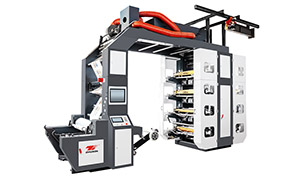
High Speed Flexo Printing Machine - Stack Flexo Flexo Printing Machine
Moisture balance: When water-based inks are dried, water vapor is removed from the ink layer, but the substrate itself also loses moisture. Paper and board have equilibrium moisture content (around 5-8%); excessive drying can reduce moisture to 2-3%, causing the substrate to shrink and warp. This shrinkage affects register – the web may become narrower and shorter, leading to color misregistration. To mitigate, some stack presses include a moisture re-conditioning system (e.g., a fine water mist spray) after the drying tunnels to restore moisture to the substrate before the next color. This ensures dimensional stability across all colors.
Temperature conditioning: The hot air also heats the substrate. If the web temperature rises significantly, thermal expansion can alter the repeat length. Moreover, a temperature gradient across the width (due to uneven heating) causes skewing. Therefore, the dryers must have uniform air distribution across the width, and the press may include a cooling section (air or chill rollers) after drying to bring the substrate back to ambient temperature before the next deck. This is especially important for film-based substrates, though stack presses are rarely used for films.
Ink cure/ dry verification: Incomplete drying leads to ink transfer onto the impression cylinder of the next deck, causing "picking" or "ghosting." Some presses incorporate an inline moisture sensor or infrared thermometer to measure the dryness after each deck. If the drying is insufficient, the press can reduce speed or increase dryer temperature automatically. For UV inks, the inter-deck space may include UV lamps, but UV curing is faster and generates less heat – making UV stack presses easier to manage.
Drying gradient and color-to-color variation: The first color may be dried under different conditions than the last color, especially if the web accumulates heat. To compensate, the dryer temperatures may be profiled – lower temperatures on early decks to avoid overheating, higher on later decks. The control system also accounts for the cumulative heat input and adjusts the drying power based on the press speed and ink coverage.
Defects from poor conditioning: If the web is too hot or too dry when entering the next deck, the ink may not transfer properly, causing poor adhesion or "ink crystalization." If the web is too moist, the board may lose stiffness and buckle. Therefore, a well-designed stack press includes a conditioning zone after each drying tunnel – a set of rollers that bring the web to a stable temperature and moisture level. This zone may include a chill roller and a slight misting.
Advanced control: Modern stack presses integrate the drying and conditioning parameters with the register control system. The system monitors the web's temperature and moisture content, and uses a model to predict its dimensional change; the register motor then compensates for the predicted shrinkage before printing the next color. This proactive approach reduces register errors due to drying-induced distortion. By mastering inter-deck drying and conditioning,
stack flexo presses can produce high-quality multi-color prints on heavy substrates, meeting the demands of sophisticated corrugated packaging, with minimal waste and consistent color registration.