Stack Flexo Press Mechanical Stiffness and Deck Alignment for Thick Substrates
The stack flexo press, with its vertical arrangement of independent printing decks, presents unique mechanical challenges when printing on thick, uneven substrates like corrugated board and heavy paper. Unlike CI presses where a common drum provides a rigid reference, stack presses must maintain alignment and stiffness across multiple decks mounted on a common frame, while each impression cylinder adjusts to variable substrate thickness. This article explores the engineering solutions for achieving stable register and consistent print quality in stack presses.
Frame design is paramount. The stack press frame is typically a heavy welded steel box structure with cross-bracing to minimize deflection under load. The decks are mounted on linear guides or machined ways that ensure vertical and horizontal positioning. The frame must be torsionally stiff to resist the twisting forces from the web tension and the individual deck drives. Finite element analysis is used to optimize the frame geometry, and many presses feature a "monoblock" design where the frame is cast as a single piece, eliminating bolted joints that could introduce play.
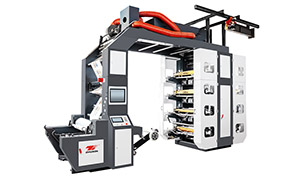
High Speed Flexo Printing Machine - Stack Flexo Flexo Printing Machine
Deck alignment: Each deck's impression cylinder, plate cylinder, and anilox roller must be parallel to each other and perpendicular to the web travel. Misalignment causes uneven nip pressure across the width, leading to print density variations and premature wear. Alignment is achieved through precision-machined mounting surfaces and adjustable spindles. Some presses use laser alignment systems that measure the position of each cylinder relative to a reference line, allowing micro-adjustments to correct any deviation. Regular alignment checks (quarterly) are recommended, especially after heavy impact or substrate jams.
Impression cylinder design for thick substrates: The impression cylinder in a stack press must accommodate substrates up to 12 mm thickness (e.g., double-wall corrugated). The cylinder has a larger diameter and a compliant surface (often with a resilient coating) to conform to the board's flutes without crushing. The impression mechanism uses either a hydraulic or pneumatic system that applies a force (not a fixed position) to maintain constant pressure regardless of thickness variations. The force is adjusted via a pressure regulator, and sensors measure the actual nip pressure to ensure consistency.
Register control in stack presses: Due to the longer web path between decks, register is more sensitive to tension variations. To compensate, stack presses employ multiple dancer rollers and tension zones. Each deck has its own register motor that can adjust the phase of the plate cylinder relative to the web. The register sensors are placed after each deck, and the control algorithm accounts for the web's travel time – a predictive feedforward term is added to the PID loop. For corrugated board, which has low stretch, register is generally easier than for films, but the board's thickness non-uniformity can cause impression variations that affect register.
Handling web flutter: The long web path in stack presses can cause the board to flutter, especially at high speeds. To mitigate, the press includes hold-down rollers or air bars that gently press the board against the transport rollers. For corrugated, the web is often guided by edge guides to keep it centered. The drying tunnels between decks are designed with low-turbulence airflow to reduce flutter.
Maintenance: The stack press's open architecture allows easy access to each deck for cleaning and adjustment. However, the large number of bearings and gears across multiple decks requires rigorous lubrication and inspection. The impression cylinders, being in contact with abrasive board, may need resurfacing more frequently than those in CI presses. A scheduled maintenance program that includes vibration analysis of each deck can detect misalignment or bearing wear early.
Performance benchmarks: A well-maintained stack press can achieve register within ±0.1 mm for 4-color corrugated post-print at speeds of 250 m/min. For pre-print on linerboard, stack presses can achieve ±0.05 mm if equipped with advanced servo drives and stiff frames. The key to success is the combination of robust mechanical design, precise alignment procedures, and responsive control systems. Stack presses continue to be the workhorse for corrugated printing, and ongoing innovations in frame stiffness and automation are extending their capability to compete with CI presses in quality, while maintaining their inherent advantage of handling heavy, thick substrates with ease.