Speed Matching Technology Between Flexo Printing Speed and Ink Transfer Consistency
This technical research focuses on the linkage mechanism between printing running speed and ink transfer volume, analyzes ink filling and scraping variation rules under variable speed, and builds an automatic speed-ink linkage adjustment model for consistent color density at variable printing speeds.
Flexo printing speed directly changes the ink filling efficiency of anilox roller cells and the scraping stability of doctor blades, further affecting real-time ink transfer volume. Under variable speed operation, fixed doctor blade pressure and fixed ink viscosity cannot adapt to changing roller linear velocity, resulting in obvious color density difference between low-speed startup stage and high-speed stable running stage, which is a common hidden quality defect in flexo production.
When printing speed increases, the rotation linear velocity of anilox roller rises synchronously, shortening the ink filling time of each micro cell. Insufficient cell filling leads to reduced single-cycle ink transfer volume and lighter printing color. Meanwhile, high-speed roller rotation enhances hydrodynamic pressure between doctor blade and roller surface, removing extra ink and further reducing final ink output.
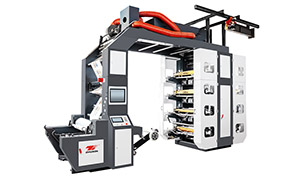
High Speed Flexo Printing Machine - Stack Flexo Flexo Printing Machine
Quantitative experimental data shows clear ink density variation rules with speed change. When speed rises from 100m/min to 300m/min with unchanged parameters, the ink transfer volume decreases by 11% for 300LPI anilox roller and decreases by 7% for 800LPI high-line anilox roller. High-line fine cell rollers are more sensitive to speed variation, meaning high-definition pattern printing requires stricter speed stability control.
Doctor blade floating vibration aggravates ink metering deviation under fluctuating printing speed. Unstable machine speed causes periodic blade vibration, forming striped light and dark color difference on printed webs. Chambered doctor blade systems have better anti-vibration performance than open single blades, reducing speed-related ink metering deviation by 68% in high-speed variable speed production scenarios.
Intelligent speed-linked ink compensation system solves speed-induced color deviation automatically. The system collects real-time running speed data, and dynamically adjusts three parameters synchronously: doctor blade contact pressure, ink circulation flow rate and ink viscosity. When speed increases, the system raises blade pressure moderately and increases ink flow to compensate insufficient cell ink filling, keeping consistent ink color density across full speed range.
Constant-speed production mode is recommended for high-end color-sensitive printing orders such as cosmetic packaging and pharmaceutical labels. Avoid frequent speed acceleration and deceleration during formal printing process to eliminate dynamic ink transfer deviation. For orders requiring frequent speed adjustment, the intelligent linkage compensation system must be enabled to ensure batch color consistency of finished printed products.