Solvent Flexo Ink Evaporation Dynamics and Solvent Retention in Film Printing
Solvent flexo inks rely on the evaporation of organic solvents to leave a resin film. The evaporation process is more complex than simple drying because the solvent-polymer interactions cause selective retention, where certain solvents (e.g., toluene, ethyl acetate) are trapped in the polymer matrix, leading to residual solvent in the printed film. This is critical for food packaging where migration limits are strict. This article examines the physics of solvent evaporation and retention.
The evaporation rate of a solvent mixture is governed by the vapor pressure of each component and the diffusion coefficient of the solvent in the ink film. As the film dries, the surface becomes enriched with the less volatile solvent (the one with higher boiling point), forming a skin that slows further evaporation – this is the "case II" diffusion in polymers. The drying curve shows a rapid initial loss of the most volatile solvents (e.g., acetone, MEK), followed by a slow, diffusion-controlled stage for the remaining solvents (e.g., ethyl acetate, toluene). The residual solvent level after typical drying (e.g., 70°C for 2 s) can be 100-500 ppm, which may exceed limits for certain food applications (e.g., <50 ppm for some regulations).
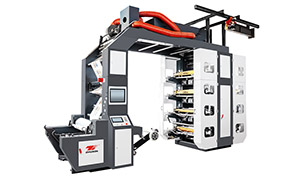
High Speed Flexo Printing Machine - Stack Flexo Flexo Printing Machine
Factors affecting residual solvent: Polymer type and Tg – polymers with high Tg (e.g., nitrocellulose) become glassy quickly, trapping solvent. Plasticizers and pigment loading also affect diffusion. Drying temperature and time are the primary controls; higher temperature increases diffusion and reduces residual, but may also cause film degradation or substrate deformation. Air flow velocity and solvent concentration in the dryer affect the driving force. The use of multiple drying zones with increasing temperature is a standard practice to gradually raise the film temperature without shocking it.
Solvent retention and migration: Residual solvents can migrate through the film and into the packaged food. The migration rate depends on the solubility of the solvent in the polymer and the temperature. To mitigate, the ink should be formulated with solvents that are less migratable (e.g., higher molecular weight) and should be dried to a level below the specific migration limit. The use of a "baking" step – holding the film at an elevated temperature for longer time – can reduce residual but reduces production speed.
Monitoring residual solvents: Gas chromatography (GC) is the standard method; headspace GC is used for in-line measurement. Some presses have an in-line solvent sensor that measures the concentration in the exhaust air, which correlates with the residual in the film. The control system adjusts the dryer temperature or press speed to maintain the residual below the target.
Substrate interactions: When printing on films, the solvent can swell the film (e.g., ethyl acetate swells PVC), causing dimensional changes and register errors. This requires careful selection of solvent blends that evaporate before significant swelling occurs. The solvent blend's evaporation profile should be balanced: a fast-evaporating solvent to set the ink quickly, and a slower one to allow leveling, but not so slow that it causes retention.
Safety and environmental: Solvent emissions must be controlled; the dryer exhaust is typically passed through a carbon adsorber or an oxidizer. The lower explosive limit (LEL) in the dryer is monitored continuously, and the system operates at 25-50% of LEL with air dilution.
By optimizing the drying parameters and solvent formulation,
solvent flexo inks can achieve low residual solvent levels suitable for demanding applications while maintaining high-speed production. Advanced drying with nitrogen inerting or vacuum-assisted drying can further reduce residual, though these are less common.