Solvent Flexo Ink Adhesion and Film Performance on Polyolefin Films with Corona Treatment
Adhesion of solvent flexo inks to non-polar polyolefin films (PE, PP) is a major challenge because these films have low surface energy (28-32 dynes/cm), while typical inks require >38 dynes/cm for wetting and adhesion. Corona treatment raises the surface energy by oxidizing the surface, creating polar groups (e.g., carbonyl, hydroxyl). This article examines the adhesion mechanisms and the role of corona treatment and adhesion promoters.
Corona treatment creates a thin oxidized layer (0.01-0.1 µm) with increased surface energy. The treatment level is measured by the water contact angle or dyne test. For good adhesion, the surface energy should be >42 dynes/cm for PE and >38 for PP. However, the effect decays over time (hours to weeks), so printing should be done soon after treatment. The treatment also increases surface roughness, providing mechanical interlocking.
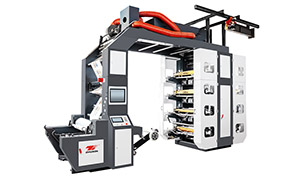
High Speed Flexo Printing Machine - Stack Flexo Flexo Printing Machine
Adhesion mechanisms: Physical adsorption (van der Waals forces) and chemical bonding (hydrogen bonds and covalent bonds) contribute. The ink's resin must have polar groups that can interact with the oxidized surface. For solvent-based inks, common resins include polyamide, nitrocellulose, or polyurethane. Polyurethane resins form urethane linkages that can hydrogen-bond with carbonyl groups on the corona-treated surface. Additionally, the solvent may swell the film slightly, allowing polymer chain interdiffusion (diffusion bonding) – this is especially effective with certain solvent blends.
Adhesion promoters (coupling agents) are often added to the ink or applied as a primer. Titanate or silane coupling agents have functional groups that can bond to both the film and the resin. For polyolefins, chlorinated polyolefin (CPO) primers are widely used; they are applied as a thin coating before printing and provide a compatible layer that bonds well to both the film and the ink. This is the most reliable method for high-demand applications (e.g., laminated pouches).
Testing adhesion: The cross-hatch tape test (ASTM D3359) is standard; the printed film is scored and tape is applied and removed. Good adhesion shows no removal. For more quantitative measurement, a peel test (90° or 180°) is used. The adhesion strength should be at least 2 N/cm for most applications.
Effect of ink formulation on adhesion: The resin choice is critical: polyamide inks adhere well to treated PE but have lower solvent resistance; polyurethane inks offer better chemical resistance. The pigment type can also affect adhesion; some pigments (e.g., carbon black) may interfere with bonding. The solvent blend must not excessively swell the film, which can weaken the boundary layer.
Troubleshooting adhesion failures: Common causes include insufficient corona treatment (dyne level below spec), contaminated film (dust, oil), ink that is too hard (excess crosslinker), or over-drying that embrittles the ink. Solutions: increase corona power, clean the film, adjust resin ratio, or reduce drying temperature. Inline corona treatment with immediate printing is the best practice.
By understanding the surface chemistry and optimizing the ink and treatment,
solvent flexo inks achieve excellent adhesion on polyolefin films, enabling durable, high-quality packaging that withstands flexing, heat sealing, and lamination.