Rheological Properties of Flexo Ink and Viscosity Dynamic Control Technology
This technical article analyzes shear thinning rheological characteristics of flexo ink, explores temperature and shear rate coupling effects on ink viscosity, and introduces closed-loop dynamic viscosity control system for stable high-speed ink transfer.
Flexo ink belongs to non-Newtonian fluid with typical shear thinning rheological property, which means ink viscosity decreases as shear rate increases. This characteristic matches flexo printing working condition: ink keeps high viscosity in ink chamber to avoid sedimentation, and becomes low viscosity under high-speed shear of anilox roller to realize smooth filling and transfer inside microcells.
Two core factors affecting
flexo ink real-time viscosity are ambient temperature and mechanical shear rate. Ink viscosity decreases by 8% when temperature rises per 5 degrees Celsius. Meanwhile, higher printing speed raises roller shear rate and further reduces ink viscosity. The dual coupling effect causes unstable ink transfer volume in variable speed and variable temperature production environments.
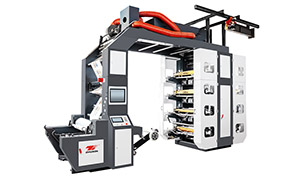
High Speed Flexo Printing Machine - Stack Flexo Flexo Printing Machine
Viscosity deviation leads to targeted printing defects in flexo production. Excessively high viscosity ink cannot fill anilox microcells completely, resulting in light printing color and missing fine dots. Excessively low viscosity ink causes ink overflow, dot gain and pattern edge blurring. Maintaining dynamic constant viscosity is the core requirement for consistent flexo printing quality.
Traditional manual viscosity adjustment cannot adapt to high-speed continuous flexo production. Manual timing detection and dilution addition have hysteresis response, unable to compensate real-time viscosity fluctuation caused by temperature change and shear action. Manual adjustment always produces 10 to 20 minutes of unstable color transition period in production.
Online closed-loop ink viscosity control system realizes real-time automatic compensation. High-precision viscosity sensors detect ink rheological parameters every 2 seconds, and the system automatically adds diluent or original ink to maintain fixed viscosity value. The system eliminates color transition period completely and keeps consistent ink rheology throughout full production process.
Differentiated viscosity set values for different anilox roller line counts. High-line anilox rollers with fine cells require higher ink viscosity to prevent ink overflow. Low-line rollers with large cells adapt to lower ink viscosity to ensure full cell filling. Matching ink viscosity with anilox roller specification is more important than unified fixed viscosity parameter for all printing jobs.